


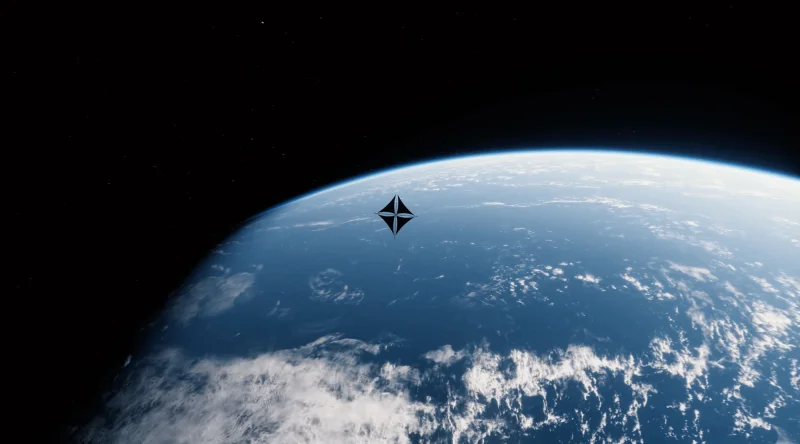
The Federal Communications Commission approved Reflect Orbital’s Eärendil-1 on July 9, clearing the company’s first satellite for a test of whether a thin-film reflector in low Earth orbit can bounce sunlight into nighttime regions. Ben Nowack called it the first step toward proving both the technology and the safeguards behind it.
The satellite will carry a reflector 18 meters on a side and is scheduled to launch later in 2025 into an orbit 600 to 650 kilometers above Earth. Reflect Orbital says the goal is not just to flash light onto the ground, but to see whether it can aim reflected sunlight at specific areas for several minutes at a time, a claim that sits at the center of the company’s pitch for space mirrors.
Nowack said the license shows the agency recognizes “the importance of testing novel technologies in space” and that the approval opens the door to rigorously testing the company’s efficacy and the safeguards it says it has developed. Reflect Orbital has also said it sees interest from users ranging from construction sites to search-and-rescue efforts, and it has floated using such satellites to reflect sunlight onto terrestrial solar farms to increase energy production. The company’s application to the FCC had been pending nearly a year.

That is also why the approval landed with a jolt in astronomy circles. Environmentalists have warned that a larger network of these satellites could disturb the daily rhythms of plants and animals, while astronomers worry about interference with telescope work and possible hazards to instruments and observers. Tony Tyson, speaking at a June 4 National Academies meeting, said the company’s plans were “even crazier” than the broadband satellite constellations astronomers have spent years worrying about, and he said he feared the thin-film reflectors would scatter light over a wider area. “Imagine the sky full of moons,” he said.
The European Southern Observatory was even more blunt in a July 1 statement, saying Reflect Orbital’s proposed 50,000-satellite constellation could raise background sky brightness at its facilities by a factor of three to four and reduce the ability of telescopes to detect faint objects. Reflect Orbital’s filing drew nearly 1,900 comments, mostly critical, even as SpaceX’s application to operate up to 1 million orbital data center satellites drew nearly 1,500. Betty Kioko said, “The ball is now in the FCC’s court, and we wait to see the determinations they make on both filings.”
The commission largely concluded that possible effects on astronomy or the environment were outside its jurisdiction, which leaves Eärendil-1 as a test not only of a new way to move light, but of how far the FCC is willing to go in policing what happens when that light reaches Earth. If the launch goes ahead later in 2025, the question will not be whether Reflect Orbital can put a mirror in orbit, but whether it can control where the light lands once it gets there.
