


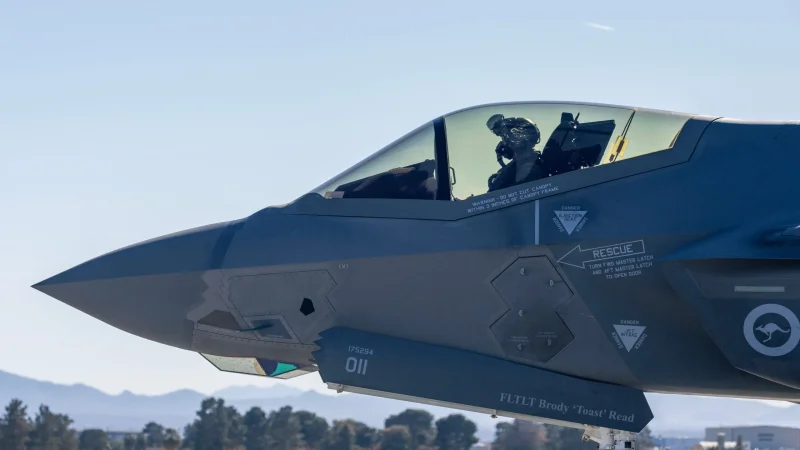
Lieutenant General Greg Masiello told lawmakers last week that the new Northrop Grumman APG-85 Radar for US F-35s will not reach its full capability until later engine and cooling upgrades arrive. The warning landed in testimony before the Senate Armed Services Committee, where Senator Mark Kelly pressed him on what the new sensor could do and when the aircraft would be ready to use it.
That matters now because the APG-85 is not just being sold as another radar. Masiello’s answer pointed to a system whose power demand may climb so far that it changes the aircraft around it. The F-35 program expects upgraded engines in 2031, with the cooling system coming a few years later, and the current aircraft cooling capacity of 30 kW would have to rise to 62 kW to 80 kW to run the APG-85 at full pace. That means the radar would more than double the cooling needed for the entire aircraft.
For the F-35 fleet, the number is the story. The program is planning around a radar that can do more than scan for targets, and the testimony put that ambition in plain language: the aircraft cannot exploit the APG-85’s “full capability” yet. In practical terms, the radar’s output is being limited not by the sensor alone but by the power and heat the jet can carry away. Until that changes, the system is ahead of the airframe that has to support it.

The wider context is high-power microwave, or HPM, technology. HPM is directed energy that targets an adversary’s radio-frequency devices with pulses of energy, including radars, communications radios and passive receivers. The article places the APG-85 in that world because a radar powerful enough to push energy outward in that way sits on the edge of a weapons debate, not just an avionics upgrade. The US Air Force demonstrated CHAMP in 2012 as a missile that could disable multiple electronic targets in a single sortie, and a senior Air Combat Command leader said in 2015 that CHAMP cost way too much. A chart from that same 2015 event mapped a path from a more compact CHAMP to a smart waveform weapon mounted on an uncrewed aircraft, showing how long the Air Force has been circling this idea.
There is also a sharp limit built into the APG-85 plan. Masiello disclosed that F-35Bs have already been delivered to the US Marine Corps without radars, and the new APG-85 is not interchangeable with the current APG-81 sensor. No other country will get the APG-85. That makes the radar a distinctly US upgrade, but also one that cannot simply be swapped in and fully used on day one. The hardware is arriving before the rest of the jet is ready for it.
So the immediate takeaway is not that the F-35 has a finished new radar, but that the program has exposed how far modern electronics are outrunning the aircraft’s present cooling and power margins. The next fixed milestone is the engine upgrade in 2031, with cooling “a few years later.” Until then, the APG-85 remains a promise with the most important part still on the schedule.
