


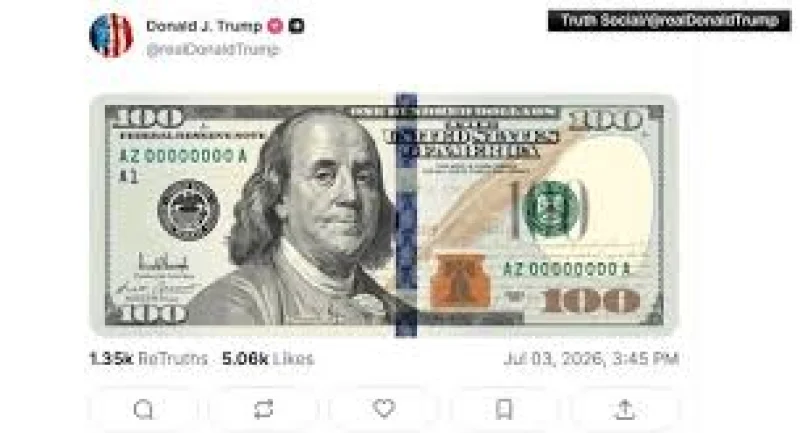
President Donald Trump put his signature on a $100 bill image and posted it on Truth Social on Friday, turning the highest-denomination U.S. banknote into the latest stage for his name. The bill also carried the signature of Secretary of the Treasury Scott Bessent, making the image look less like a joke than a deliberate message sent just in time for July 4th.
The post landed after earlier reports this year that Trump was set to become the first sitting president to have his signature on banknotes, and it came with the added detail that the first $100 bills with his signature were reportedly printed in June. That alone was enough to set off attention, because banknotes have traditionally carried the signatures of treasury officials rather than presidents, and the question hanging over the image is whether it is an official redesign, a commemorative concept, or only a social-media provocation.

The numbers around the story only sharpen the oddity. Since 1861, the treasurer’s signature has been part of the standard look of banknotes, and the Trump administration has already ended that practice. Previous bills carried the signatures of President Joe Biden’s Treasury Secretary Janet Yellen and Treasurer Lynn Malerba, a reminder that the names on currency usually belong to people in those offices, not to the president at the top of the ticket. Treasurer Brandon Beach said the country’s currency will continue to stand as a symbol of prosperity, strength, and the unshakable spirit of the American people.
That is where the friction sits. Federal law does not allow a living president to appear on U.S. currency, yet Trump’s post showed a bill bearing his signature and invited the comparison anyway. In March, Scott Bessent said there was no more powerful way to recognize the historic achievements of the country and Donald J Trump than U.S. dollar bills bearing his name, and the White House has already moved to associate the president’s name with a wider set of government symbols in his second term. On Truth Social and X, supporters and critics treated the image as another sign of how far the currency conversation has drifted from routine banking to political branding.
For now, the image is the story, not a finished policy. The post does not confirm any official redesign or printing plan beyond what has already been reported, and that is exactly why it matters: Trump has now put the question of his name on U.S. dollar bills in public view, and he did it on the eve of July 4th, when symbolism tends to travel faster than clarification.
