


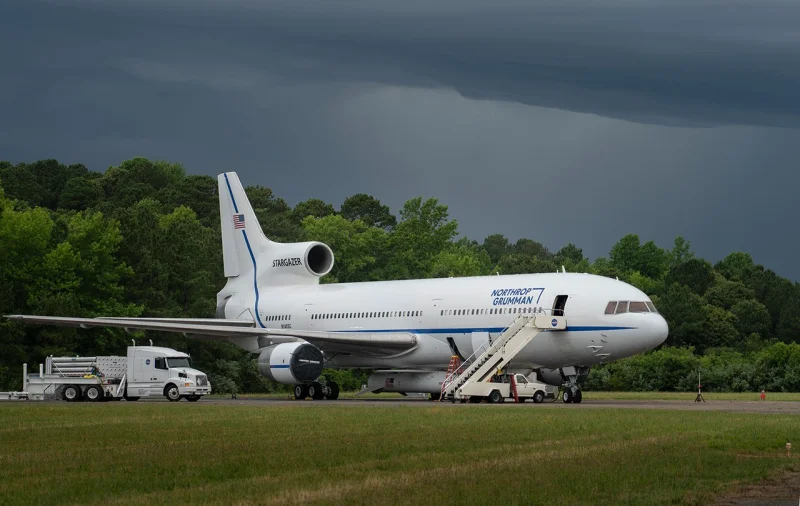
NASA is preparing to launch the Swift boost mission in June in an effort to pull the Swift Observatory back from a path toward reentry. If the rescue works, the telescope that has spent more than two decades in Earth orbit could keep working for several more years instead of burning up in the atmosphere.
The move answers a problem that has become harder to ignore. Swift, launched in 2004 and built to study gamma-ray bursts, has fallen faster than NASA expected after increased solar storms since fall 2024. The observatory sits in low-Earth orbit with three telescopes that collect visible, ultraviolet, X-ray and gamma-ray light, and that altitude leaves it vulnerable when drag starts to win.

That is why the mission has drawn unusual attention now. NASA and commercial aerospace partners have raced against the clock, and the effort would be the first of its kind if it succeeds: a commercial robotic spacecraft capturing a government satellite that was never meant to be serviced in space. Katalyst Space won the $30 million contract in September 2025 and built the 880-pound, 5-foot LINK spacecraft for the job.
The uncertainty is stark. NASA could still let Swift fall back to Earth and burn up in the atmosphere, while Katalyst Space says the satellite already has a 50% chance of uncontrolled reentry by mid-2026 without intervention, rising to 90% by the end of 2026. That gives the June launch window real urgency, because every month that passes narrows the margin for a rescue that has to work the first time.
S. Bradley Cenko, who has been leading the science side of the observatory's work, said he is looking forward to getting back to Swift's science after the boost is complete. That is the point of the mission in plain terms: save a telescope that still has work to do, avoid the cost of replacing it, and prove that a spacecraft never designed for repairs can still be pulled back from the edge.
