


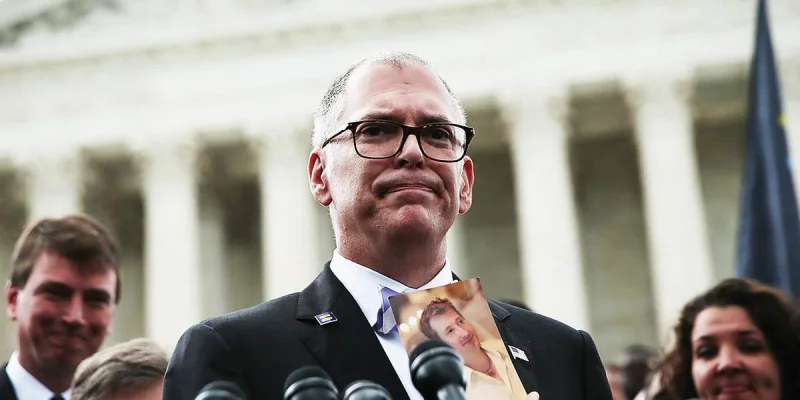
Jim Obergefell says it breaks his heart that the ruling bearing his name could be overturned, even after it made same-sex marriage legal nationwide in 2015. He said there are still times he has to remind himself that when he hears or sees Obergefell in the news, it is not just a case — it is him.
That reaction lands now because conservatives are openly discussing whether Obergefell v. Hodges can be reversed, more than a decade after the U.S. Supreme Court issued the decision. The possibility has put fresh attention on one of the most consequential constitutional rulings in modern American history, and on what happens if a right that seemed settled in 2015 is treated as fragile again.
The scale of what is at stake is larger now than it was when the case was decided. More than 823,000 married same-sex couples now live in the United States, according to 2025 estimates from the Williams Institute at UCLA School of Law. In 1996, when Congress passed the Defense of Marriage Act, national support for marriage equality was below 30 percent. Today it hovers near 70 percent, with support among Democrats above 85 percent and majorities of younger Republicans also in favor.

That split is what makes the renewed talk of reversal so striking. A legal outcome that once moved far ahead of public opinion now sits inside a country where public support has risen sharply, yet the ruling is still being talked about as if it could be pulled back. Obergefell said, “We should not feel safe in any of the rights we enjoy,” and his warning fits the moment: the law may have changed in 2015, but the political fight around it has not ended.
His own case began in hospice care with John Arthur, his late husband, and a fight to make sure Arthur’s name appeared correctly on a death certificate. That personal battle became the path to the Supreme Court decision that changed marriage law nationwide. For Obergefell, the newest threat is not abstract. It is a reminder that even victories written into constitutional law can be reopened when the politics around them shift.
What remains unanswered is how far the effort to overturn the ruling could go, and whether the challenge would come through the court itself or through a broader legal campaign. For Obergefell, the name that once belonged to his family’s fight now marks a test of whether the country still means what it said in 2015.
