


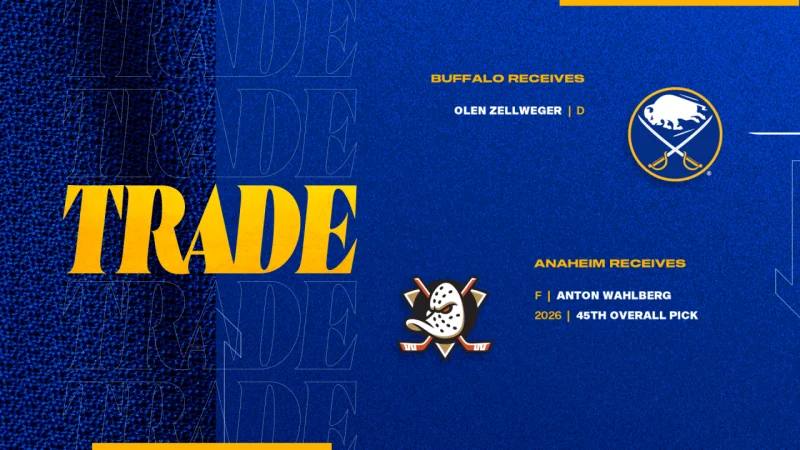
The Buffalo Sabres acquired Olen Zellweger from the Anaheim Ducks on June 26, 2026, paying with prospect center Anton Wahlberg and the No. 45 pick in the 2026 draft. It is a straight hockey trade with a real swing in age, position and ceiling: Buffalo gets a 22-year-old defenseman, while Anaheim turns one young blueliner into a draft pick and a center prospect.
Zellweger enters the move as a pending restricted free agent without arbitration rights, which gives Buffalo a clean opening to shape his next deal and role. He has 51 points in 164 career NHL games, and that total is the reason the Sabres could be comfortable moving for him now. At 5’10” and 193 pounds, he is not being acquired for size. He is being acquired for the idea that his puck skill can still become more than it has been in the NHL.
That idea has real support, just not all at this level. Zellweger produced 37 points in 44 AHL rookie games and scored 29 points in a 14-game WHL playoff run, numbers that explain why he was chosen in the early second round in 2021. He also has been a full-time NHL player for the last two seasons, after breaking in as a 20-year-old rookie late in the 2023-24 season. The problem for any team trying to project him is that the offensive pop has not yet carried over in the same way in the NHL, even though he has become a regular.
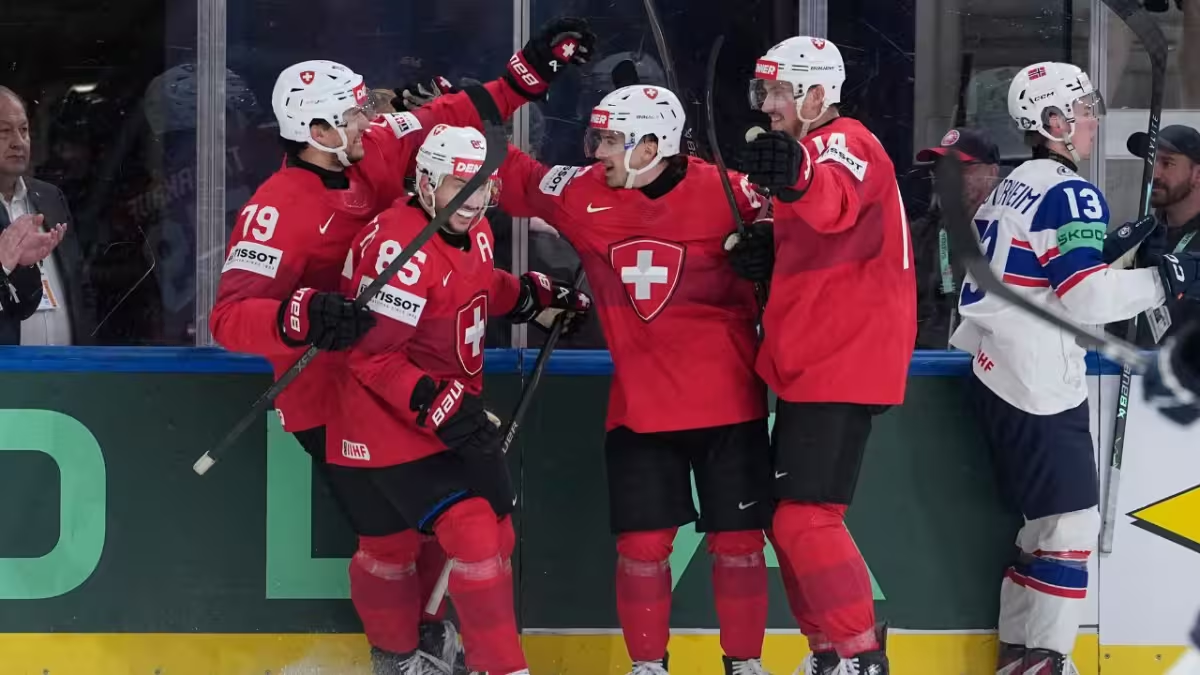
His usage tells the same story. In 2024-25, Zellweger averaged 18:57 of ice time per game and 2:24 per game on the power play, the top power-play figure among Ducks blueliners. This past season, though, he was down to just under 17 minutes a night. That drop matters because it hints at how Anaheim viewed his place in the lineup, and why a team such as Buffalo could see value in buying lower on a player whose most obvious skill has not been fully unlocked yet.
Buffalo also had a roster reason to act now. The Sabres had already moved Bowen Byram, who had quarterbacked their second power play unit, so the trade for Zellweger helps refill a spot that was open in function if not in name. He could end up paired with right-hander Louis Crevier on the third pairing, and the addition could push Zach Metsa down the depth chart. That is the part of the deal that makes sense on paper: Buffalo is taking a defenseman with NHL games, special-teams experience and room to grow, then deciding where the fit is best after the fact.
Anaheim’s side is harder to miss. The Ducks are deep enough in young defensemen that moving Zellweger made sense as asset management, especially once the return included a second-round pick and Wahlberg. Buffalo gets the player most likely to help sooner, while Anaheim gets the broader package. What remains unresolved is the same question that followed Zellweger before the trade: whether the next team can turn his junior and AHL scoring into something that lasts in the NHL.
