


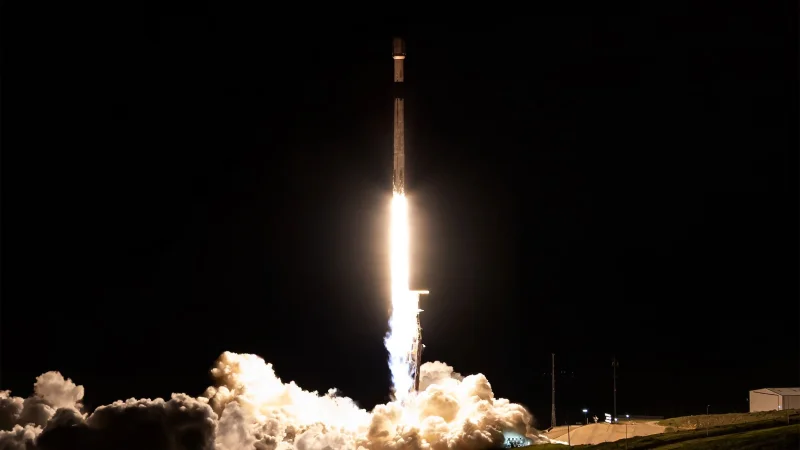
SpaceX is set to send another 24 Starlink satellites into low Earth orbit tonight from California's central coast, with a Falcon 9 launch scheduled for 11:19 p.m. EDT from Vandenberg Space Force Base. The company said live coverage will begin about 10 minutes before liftoff.
The booster assigned to the flight, B1081, is scheduled for its 25th trip to space, a mark that shows how routine heavy reuse has become even on a mission that is still adding to the biggest satellite network ever assembled. If the countdown holds, the Falcon 9's first stage will land on the SpaceX drone ship Of Course I Still Love You in the Pacific Ocean about 8.5 minutes after launch, and the satellites should separate just under 62 minutes into flight.

This launch will be the 74th Falcon 9 liftoff of the year and the 59th Falcon 9 launch of 2026 devoted to building out Starlink. That network now has nearly 10,700 active units, so even a single 24-satellite batch keeps pushing the constellation closer to full scale. For viewers tracking SpaceX launch today, the timing is tight enough that the live stream matters as much as the mission itself.
The contrast is plain: a rocket stage flying for the 25th time is now handling what would once have been treated as a major mission, but here it is carrying out a standard Starlink deployment. SpaceX has kept up that pace alongside other recent launches, including a Falcon Heavy flight on April 29 and Starship's 12th-ever test flight on May 22, underscoring how much of its schedule now turns on fast, repeatable turnaround.
For the moment, the only confirmed next step is the planned liftoff at 11:19 p.m. EDT, followed by landing on Of Course I Still Love You and satellite deployment a little over an hour after launch. If the rocket flies on time, it will be another small increment for Starlink and another sign that SpaceX's reuse model is now the rule rather than the exception.
