


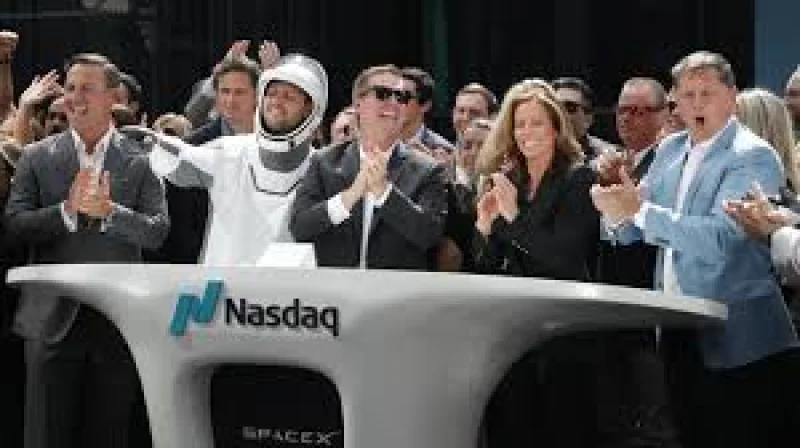
SpaceX was valued at more than $2.4 trillion as of Thursday, a number that would make Elon Musk’s company one of the world’s most valuable firms even though it has yet to show a proof of concept for the space-based data center plan behind that valuation.
The figure places SpaceX as the world’s sixth-most-valuable company and explains why investors are searching for stock market news today around a business that, by its own recent pitch, is still being priced on promise. SpaceX made its debut on the public markets last week after laying out its case in documents ahead of the offering, and the valuation has become a live test of whether a company can be measured more by the scale of its ambition than by the performance of the business it has already built.
Musk said on Thursday that putting data centers in space was always going to be the solution, a line that fits the company’s broader plan to become a hub for computing power overhead. He has also framed the idea as something that can expand far beyond Earth’s limits, saying it could scale a trillion times more than on Earth and tying the pitch to a colony of a million people on Mars. That is the logic carrying the valuation: not present-day revenue, but a future in which space itself becomes the infrastructure.

Greg Martin called orbital data centers a complete game changer and said they solve the real estate problem, the power problem and the cooling problem. Ben Wild, who said he was once skeptical, now argues the concept is technically feasible. “From a technical standpoint, the fundamentals of orbital data centers are sound,” he said. “In the right orbit, you can generate continuous solar power and reject heat directly into space, removing two major constraints on terrestrial AI infrastructure.”
That case matters because SpaceX has lost $13 billion since the start of 2023, yet it is being valued far above many established companies on the strength of a plan that still lacks even a working example. Anthropic and Google have already made deals with SpaceX to rent data center capacity on Earth, giving the company some commercial footing, but not evidence that the orbital version works. The gap is the whole story: a money-losing rocket start-up is being priced as if the next great computing platform is already within reach.
For now, the market is treating SpaceX as both a rocket company and a wager on an entirely new computing frontier. The next question is not whether the idea sounds bold; it is whether SpaceX can turn a pitch about space-based data centers into a business with proof, capacity and cash flow before the valuation outruns the story that supports it.
