


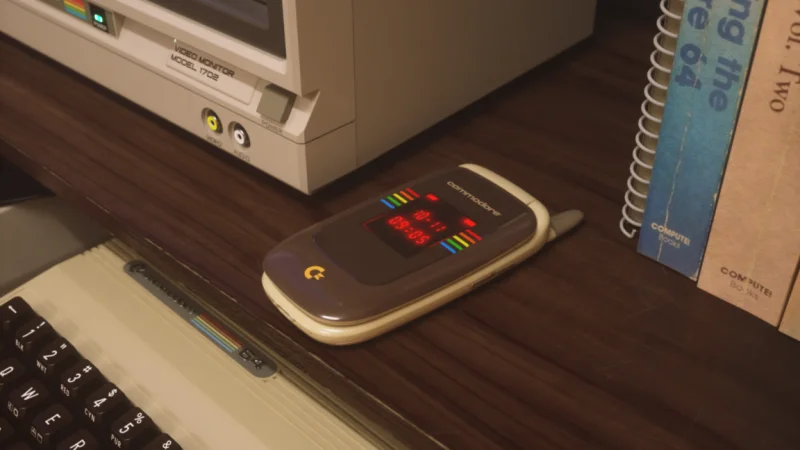
Commodore has announced the Callback 8020, a flip phone built to keep social media and web browsers out at the system level. The device runs Sailfish OS, supports maps and QR codes, and is meant to give buyers a tighter phone without turning it into a dead end.
The timing matters because the Callback 8020 lands as interest in simpler phones keeps building, and Commodore is selling a very specific version of that idea: one that keeps internet access, but only on the company’s terms. Christian “Peri Fractic” Simpson said the acquisition price for the Commodore name was in the low seven figures, and the new phone is part of a push that has already produced the Commodore 64 Ultimate and the Commodore 64X PC.
Commodore says the Callback 8020 is not just a novelty shell. It will support over 99 percent of Android apps through Sailfish OS’s Android runtime app compatibility layer, and it will also handle Spotify, Signal and WhatsApp. The phone adds Commodore 64-era games, a dome-shaped LED that lights when a message arrives, an exterior screen with a red tint that recalls 1970s Commodore calculators, and an 8-bit SID music player for music made for the SID chip in the original Commodore 64.
That breadth is what makes the restrictions stand out. Simpson said social media and browsers will never be whitelisted in Commostore, and that users can sideload nearly anything else if it is not available there. He also said the phone blocks access at the DNS level, which means even if TikTok is installed it should not reach its servers. Old school bulletin board systems are allowed, but Reddit is not.
Commodore is trying to draw a line between a connected phone and an addictive one, but that line depends on policy as much as software. The company says it will consult with the Callback community over the next few months on additional rules, leaving open the question of how far the blocking system can go if users try to work around it.
