


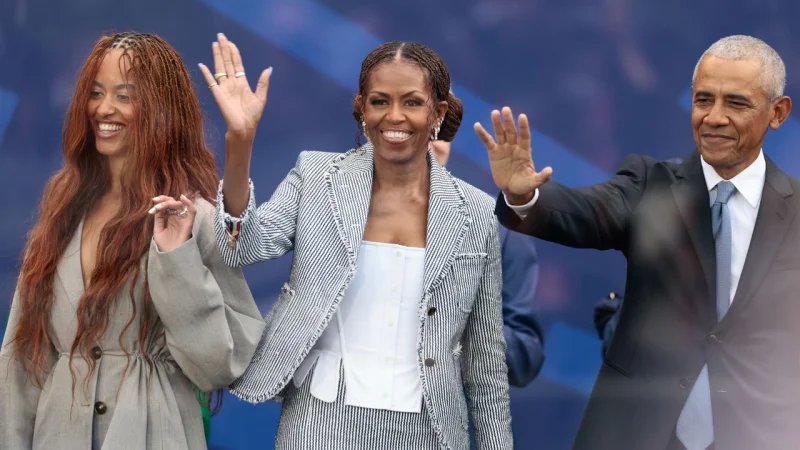
The Obama Presidential Center opened Thursday with a grand dedication ceremony in Illinois, turning a long-promised project into a live public gathering on Chicago’s South Side. Michelle Obama was there in a tweed skirt suit by Thom Browne, as the campus welcomed politicians, celebrities and other well-wishers to Jackson Park.
The day had the feel of a political reunion and a cultural event at once. Former President Joe Biden and Dr. Jill Biden were in the room, along with Bill Clinton and Hillary Clinton, Kamala Harris and Doug Emhoff, Nancy Pelosi, Illinois Gov. JB Pritzker, California Gov. Gavin Newsom, Hakeem Jeffries, Dick Durbin, Rahm Emanuel, Eric Holder, Gabrielle Giffords, Mark Kelly of Arizona, George W. Bush and Laura Bush, Al Sharpton, Valerie Jarrett, Angela Merkel and Justin Trudeau. Christina Aguilera, Marc Anthony, Tom Hanks and Oprah were among the biggest stars, while Oprah Winfrey, Gayle King, Karlie Kloss and Derek Blasberg were named together among the guests who filled out the crowd.
Built on a 19-acre campus in Jackson Park, the center is more than a museum. It includes a four-story museum tower, a recreation area, a new branch of the Chicago Public Library and landscaped lawns, paths and gardens, making it a place meant to be used as well as visited. The design comes from Tod Williams Billie Tsien Architects, working with Interactive Design Architects, and the mix of civic space, green space and public programming gives the site a daily life that goes beyond a ribbon-cutting.
That broader promise sat beside a quieter fact: the opening celebration was carried by star power and bipartisan names, but the day itself did not surface the arguments that often shadow big civic projects of this scale. Instead, Barack Obama used the occasion to say he hoped the OPC would "serve as an affirmation of just how special, how precious, our democracy truly is." Michelle Obama’s arrival, and the attention around what she wore, underscored how much of the center’s public identity is still tied to the family that gave it its name.
The real question now is not whether the center can draw a crowd. Thursday answered that. What comes next is whether the OPC can turn a ceremonial opening into an everyday institution, with the museum, library, recreation spaces and gardens used as a working part of city life rather than a destination people see once and leave behind.
