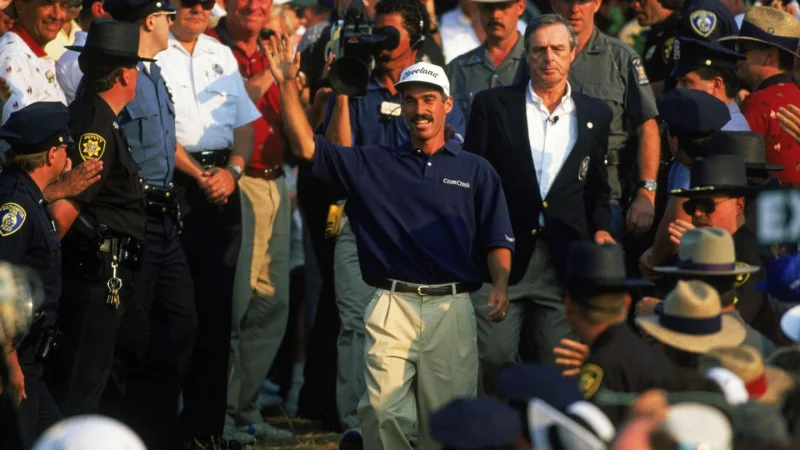
Corey Pavin was 228 yards from the pin on the final hole of the 1995 U.S. Open when he took out a 4-wood and sent one of the coldest shots of his career toward the green. He was 35, standing over a par-4 18th hole at Shinnecock Hills with a one-shot lead and the knowledge that par or better would likely give him his first major championship.
That is why the shot still travels. Pavin was not playing from comfort. He had found the right side of the fairway, but he could barely make out the flagstick on the elevated green. With the wind blowing 15 to 20 miles an hour right to left, he chose to aim at the right edge of the green and shape a little draw, a calculation that had to be exact or the lead could vanish in a single swing.
Pavin later said he could see only the top of the flag and knew that was all he had. The moment he struck the 4-wood, he knew it was good. The ball came off with the kind of flight only pressure can produce, a small draw that landed in the rough in front of the green and bounced up toward the hole. On the NBC broadcast, Johnny Miller cut through the noise: “Watch out for this one! This is the shot of his life!”
The shot mattered because Greg Norman, one of the best players in the world at the time, was still one shot behind and two groups back, with enough golf left to punish any slip on the last green. Pavin’s approach did not finish the tournament by itself, but it removed the final doubt from a round played under a heavy wind and even heavier stakes. It also answered the question that has followed the shot for years: yes, it was the kind of swing that set up his first major title.
Shinnecock Hills Golf Club was again the stage for the championship, and the club Pavin used that day is the kind of choice that would not sit in every bag when the tournament began on Thursday. That is part of what gives the moment its force. A 4-wood is a longer fairway club, one built to launch the ball high enough and far enough when the player needs distance but still wants more control than a driver or long iron might offer. On that day, under that wind, from that yardage, Pavin chose the club that let him commit. The result remains one of the most pressure-filled swings in U.S. Open memory.