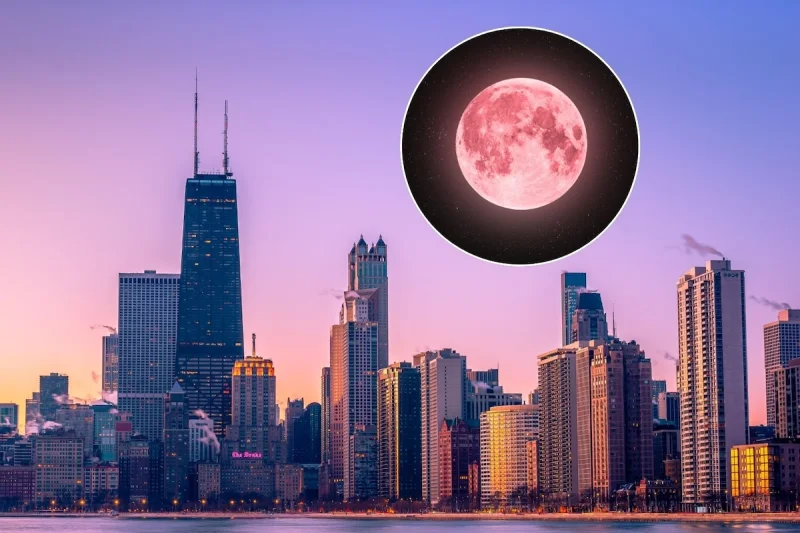
Chicago skywatchers have a date and a minute to watch for on Tuesday, June 29: the Strawberry Moon will reach peak illumination at 6:56 p.m. The full moon will start rising in the late afternoon, giving people in the city a narrow window to catch it as it climbs.
The timing matters because the Strawberry Moon comes around every June, shortly after the Summer Solstice, and it is one of those recurring sky events that still pulls people outside when the light is right. In Chicago, the best viewing spots are the places that fight the city’s glow the least, which is why lakeside locations such as the Adler Planetarium peninsula and the Montrose Moonrise Observation Point are favored for a clear look.
The moon’s name can be misleading. Despite the sweet label, it is not actually pink, and as it first lifts above the horizon it may look yellow or orange before brightening overhead. That shift has more to do with the atmosphere than the moon itself, which is why the first glimpse can look different from the view a little later in the evening.
There is also a small catch for anyone planning around the sky. The event is tied to visibility, and Chicago weather can decide how much of the show people actually get to see. A bright moon may be ready on schedule, but thin clouds or a hazy evening can mute the view, leaving the timing intact even when the scene is not.
For Chicago, the Strawberry Moon is part astronomy and part seasonal marker. It is the final full moon of spring or the first of summer, depending on how it is counted, and its name traces back to the traditional strawberry harvesting season rather than anything in the color of the moon itself. That is also why the search around it starts early every June: people want the time, the place and the small bit of sky lore that goes with it.
The next step is simple. Watch for the moon in the late afternoon, then look again at 6:56 p.m. on Tuesday, June 29, when it reaches peak illumination over Chicago. If the sky cooperates, the lakeside should offer the cleanest view; if it does not, the moon will still be there, just harder to see.