


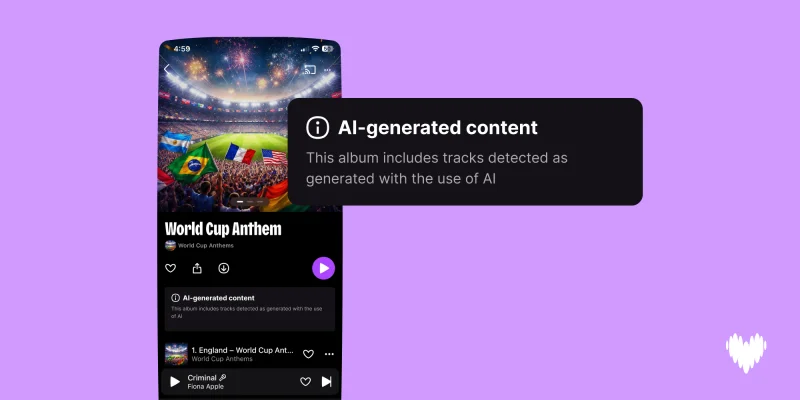
Deezer said on June 8 that a wave of football anthems had already started to flood its platform ahead of this year’s World Cup, with more than 270 tracks named World Cup 2026 uploaded and over 70% of them labeled as AI-generated. It also said more than 150 songs called FIFA World Cup 2026 had appeared by the same date, with over 65% flagged as AI.
The timing matters because unofficial World Cup songs have become a fast-moving internet business this year, and the race to capture search traffic is already visible in streaming data. Deezer pointed to the viral French anthem Imbattables by AI music creator Crystalo as one of the best-known examples, saying it had racked up millions of views across social media and music streaming platforms.
Deezer’s numbers suggest the surge is not limited to a single title or one market. In France, the platform said there were more than 70 songs listed in albums called Coupe du Monde 2026, and 86% of them were detected as AI-generated. In Brazil, it said there were over 180 songs published in albums called Copa do Mundo 2026, with 71% identified as AI. The company said its detection system now finds more than 75,000 fully AI-generated tracks every day, equal to roughly 44% of all daily uploads.
That flood has a built-in ceiling. Deezer said AI-generated tracks are excluded from algorithmic and editorial recommendations, which means they are unlikely to gather more than a few streams once detected. The platform also said up to 85% of AI-generated music is caught as streaming fraud, removed from royalty calculations and never paid for. That is a sharp contrast with the kind of reach Crystalo has already seen outside the service, where millions of views can build a viral hit before platform controls catch up.
The company’s own view of the market is that the problem is only getting bigger. It said it is the first and only streaming platform to automatically detect and transparently label AI-generated music, and it cited a 2025 Ipsos survey of 9,000 respondents in which 80% said AI music should be clearly labeled. Whether the World Cup flood produces a handful of human-made anthems or mostly machine-made imitations may be the more relevant question now, because Deezer has already made clear that the songs it identifies are being pushed out of the algorithm before they can build much of an audience.
