


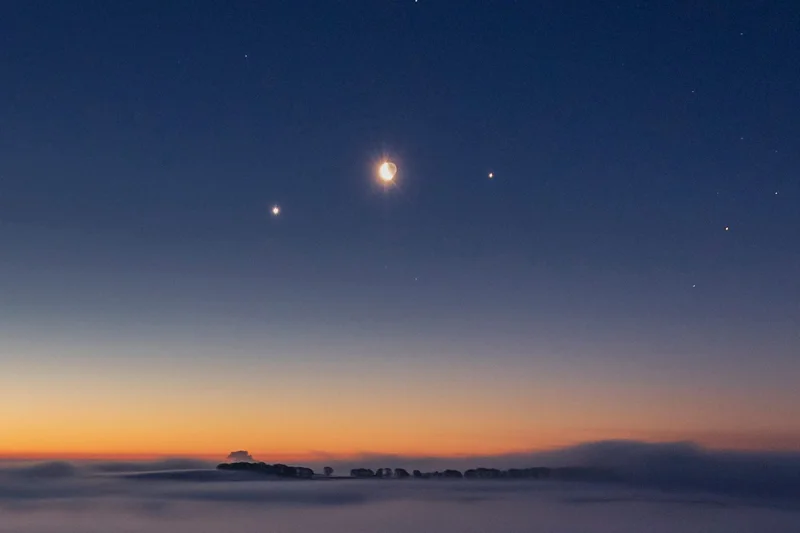
Venus and Jupiter met in the twilight sky on June 9, shining less than 2 degrees apart in Gemini. The close planetary pairing drew the eye of skywatchers and photographers who had been following the two planets as they moved toward one another over the past few weeks.
For many observers, the appeal was simple: a rare-looking scene that was easy to recognize and brief enough to feel urgent. The conjunction put the planets into the same patch of sky just as evening light faded, a combination that turned a routine bit of celestial motion into a photo-worthy event, with Mercury lurking nearby in the same western sunset sky. Readers looking up for Venus tonight may also have been drawn to earlier coverage of the pairing, including Venus And Jupiter Tonight: Close June 9 pairing lights the western sky and Planet watchers get a close Venus-Jupiter pairing in the western sky tonight.
Josh Dury captured one of the most striking images of the approach on June 8, with Venus and Jupiter hanging above the prehistoric Avebury stone circles in Wiltshire, U.K. He said the stones seemed almost to mirror the angle of the planets, and described the scene as looking like a couple gazing up at the wonders of the universe.
Other photographers found the same alignment in very different places. Cheng Xin photographed the planetary duo over Shenzhen in Guangdong Province, while Riste Spiroski framed the planets above the rooftops of Skopje, the capital of North Macedonia. Yasser Al-Zayyat recorded Jupiter and Venus above the Kuwait City skyline on June 9, and Osama Fathi captured them over the volcanic mountains of Egypt's Black Desert on June 6 using a Nikon Z6 camera with a Nikon Nikkor 24 mm lens.
The visual drama came from a trick of perspective, not a physical meeting. Venus and Jupiter were separated by hundreds of millions of kilometres in space even as they appeared close together from Earth, and that contrast helped make the conjunction one of the year's most beautiful celestial sights. Spiroski said he was drawn to the image because of the contrast between a couple focused on a phone and the rare event overhead, a reminder that the scene worked as much as a photograph of human attention as it did of the sky.
The planets will now move apart again, ending the brief alignment that made the June 9 search so common. What this round of images leaves unanswered is not whether the conjunction happened, but which viewing conditions made it easiest to see from each place; the photographs show how widely it was noticed, even if the sky did not look the same everywhere.
