


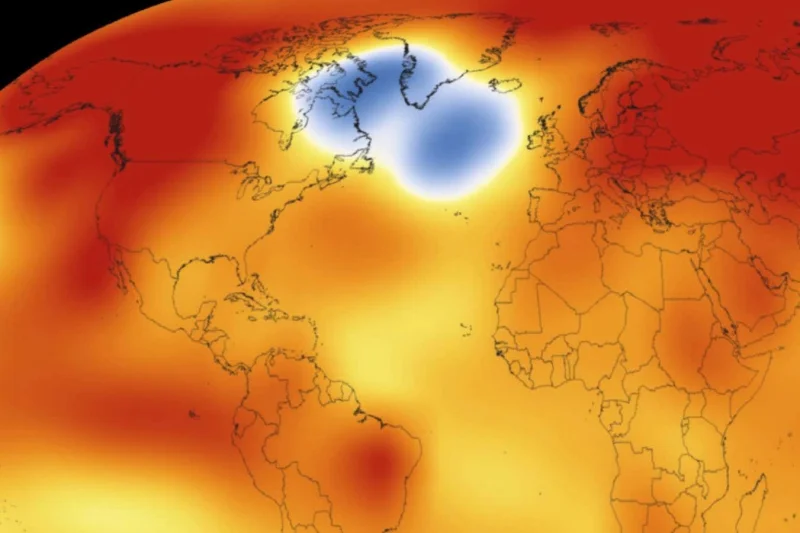
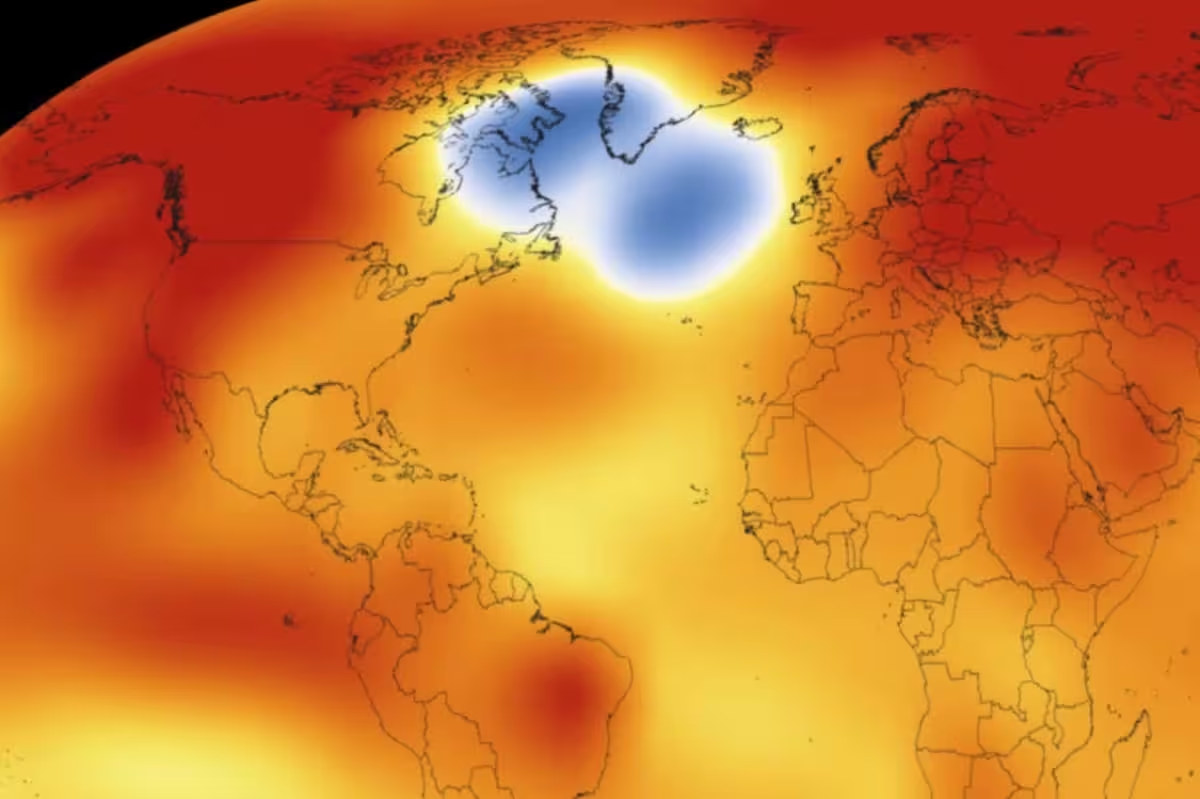
A patch of ocean south-east of Greenland that has long puzzled scientists may be telling a bigger story about the Atlantic. New analysis suggests the so-called cold blob is not being driven mainly by the atmosphere, but by a weakening Atlantic Meridional Overturning Circulation, the current system that helps carry warmth north.
The region has cooled by as much as 1°C and remains the only place on Earth that is cooling while much of the planet warms. That is why the cold blob, also known as the warming hole, is getting renewed attention now: it may be a visible sign that a major ocean system is changing, with consequences far beyond the North Atlantic.
Stefan Rahmstorf and colleagues examined the patch using climate reanalyses built from direct weather observations from satellites, buoys and ships. They found that heat loss from the ocean surface in the area has decreased since 1955, and that the cooling is not confined to the top layer. The ocean has cooled there not just near the surface but also down to 1000 metres, which the researchers say fits with less heat being carried north by the AMOC rather than extra heat being removed by winds.
The Atlantic circulation in question moves warm, salty water from the Gulf of Mexico toward the north Atlantic. There it cools, sinks and flows back south along the ocean floor. Scientists have worried that freshwater from Greenland’s melting ice is making that salty water less dense, and some research suggests the system could cross a tipping point within decades. A collapse would not stop at the North Atlantic. It could freeze Europe and disrupt monsoon rains that support agriculture in Africa and Asia.
That is where the argument has split. Some modelling has placed most of the blame on the atmosphere, pointing to a 2022 study that linked rapid Arctic warming, a northward shift in the jet stream and stronger westerly winds to more evaporation, more cloud cover and less sunlight reaching the sea. Rahmstorf’s team says the data point in a different direction. As he put it, winds and clouds “only explain a modest fraction of the warming hole,” and even where models make an atmospheric case plausible, “in fact, the data show it is caused by the ocean.”
He said the finding shows Atlantic Ocean circulation has already been changing for decades, and it raises concerns not just about the AMOC but also about the subpolar gyre. The hard limit is that scientists still have only 22 years of direct observations of AMOC strength, far too little to say how close it is to a tipping point. The cold blob may be one of the clearest public clues yet, but the next decisive step will be watching whether the circulation keeps weakening, or whether the Atlantic steadies before the anomaly grows larger. For more on the regional signal, see Amoc cold blob off Greenland points to decades of Atlantic weakening.
