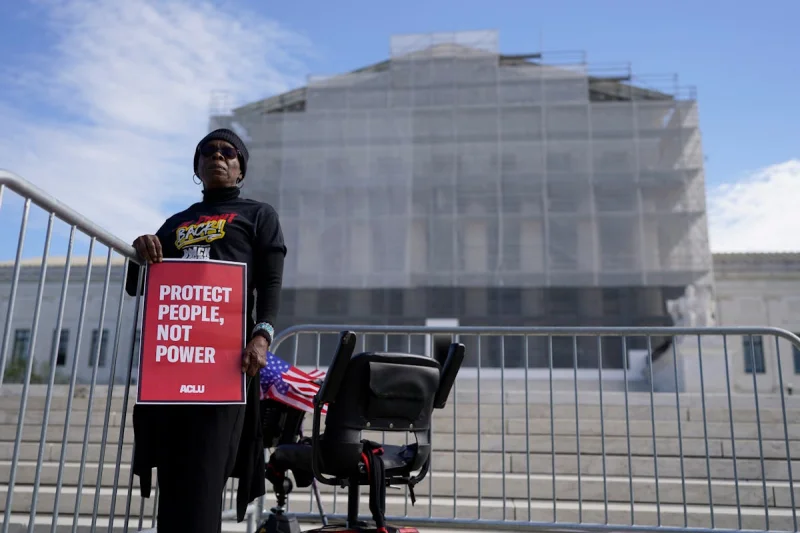
The Supreme Court’s decision in Louisiana v. Callais is being read as a fresh blow to Section 2 of the Voting Rights Act, and one that lands hardest far from Washington. The ruling is described as cutting away at the law’s protections for local governments, where it has most often been used to challenge voting rules that lock minorities out of power.
That is why people are searching the case now. The public fight over Callais has centered on what it could mean for Congress and the 2026 midterms, but the more immediate effect may be on school boards, county commissions and city councils, where voting-rights cases have historically done most of their work. In practical terms, the decision could narrow one of the main legal tools communities have used to challenge local election systems that dilute Black and Hispanic voting strength.
David Tyson Jr. knows that terrain better than most. In 2018, he sued Richardson Independent School District in Texas under Section 2 after the district’s 164-year history had produced only one person of color on the school board. Tyson’s case focused on a district where white students made up less than 30 percent of enrollment while Black and Hispanic students made up nearly 60 percent, yet the board stayed stubbornly white. He described Richardson as a “tale of two districts,” and the numbers matched the split: elementary schools where at least 70 percent of students met grade level in two or more subjects were two-thirds white, while the lowest-performing schools were predominantly Black, Latino and economically disadvantaged. The district’s best elementary school was predominantly white; the worst was predominantly Latino, and there was a 60-point gap between them.
Section 2 was enacted to stop state and local governments from adopting voting rules that result in racial discrimination, and it has been used most often in local electoral fights rather than at the state level. That is what made it so consequential. In district after district, it allowed voters to force changes that produced diverse school boards and city councils, including places where national minorities could govern as local majorities. Tyson’s lawsuit was part of that tradition, aimed at a system in which white students were a minority in the schools but white voters still held a majority in the district’s population.
Callais, by contrast, may leave its darkest mark at the local level. The case is being discussed as if its biggest political ripple will come in Congress, but the deeper damage may be to the institutions people rely on closest to home. If Section 2 has been the legal backstop for challenging discriminatory local maps and voting practices, the Supreme Court has now made that backstop far less reliable. Justice Kagan’s warning that the law could become “all but a dead letter” captures the risk: local governments may still draw lines, but the communities most often protected by Section 2 will have a much harder time forcing them to do it fairly.
What remains unsettled is how far the ruling will reach in the next round of local voting-rights fights. For Tyson and others like him, the question is no longer whether Section 2 matters in school board races and city halls. It is whether the courts will still let it work there at all.