


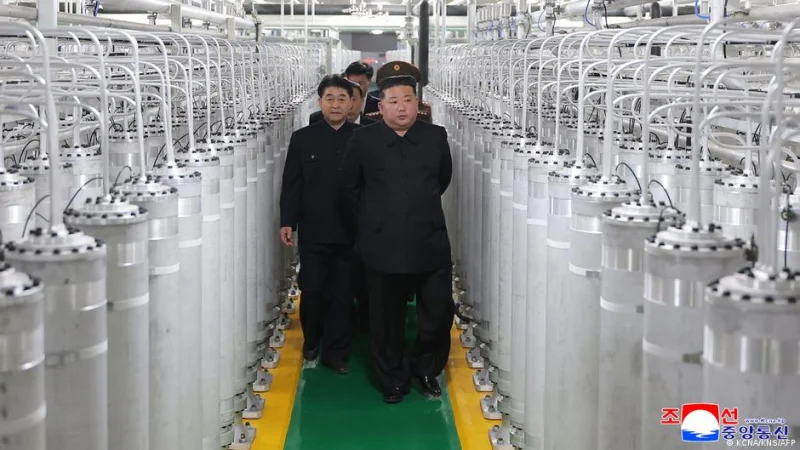
Kim Jong Un toured what South Korea said was likely a new uranium enrichment plant this week and then used the visit to announce that North Korea would expand its nuclear forces at “an exponential rate.” The timing matters because it showed, in public and in detail, that Pyongyang is not pausing for diplomacy or sanctions pressure.
The visit came days after North Korea’s Foreign Ministry said denuclearization would “never happen,” a declaration that answered fresh calls from the foreign ministers of the US, Japan, India and Australia for the complete denuclearization of North Korea after a meeting in New Delhi. Kim has spent years hardening that line. In February 2026, he declared North Korea’s status as a nuclear state “completely and absolutely irreversible,” and he has said any negotiation with Washington depends on the US recognizing his country as a nuclear-armed state.
The plant itself is the most tangible sign yet of where the program is headed. North Korea amended its constitution in 2023 to enshrine its nuclear force-building policy, and since then its arsenal has only become a more explicit part of state doctrine. In early May 2026, South Korean intelligence said Pyongyang had codified an automatic nuclear launch policy into law if its central command system or Kim himself is targeted by hostile forces.
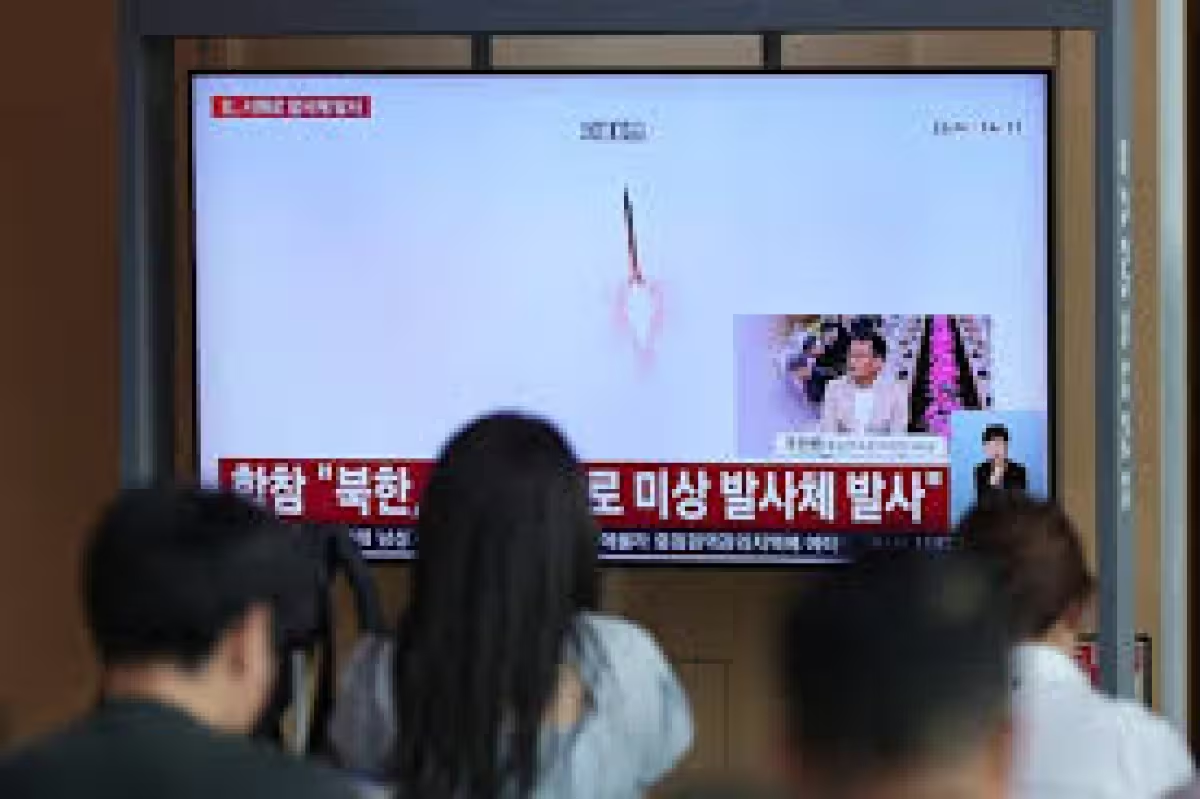
That track is what worries Washington and its allies. In April 2026, Robert Kadlec, the US assistant secretary of defense, told the Senate Armed Services Committee that North Korea’s nuclear forces are “increasingly capable of targeting the US.” He also said the country’s missile forces “can strike South Korea and Japan with nuclear or conventional warheads,” while the US intelligence community’s 2026 Annual Threat Assessment said in March that North Korea is committed to expanding its strategic weapons programs, including missiles and nuclear warheads, to solidify its deterrent capability.
The friction is that the diplomatic endgame has not disappeared, even as Pyongyang insists it has. Kelsey Davenport has argued that the US and its allies should not give up on denuclearization as a goal, but Kim has repeatedly framed talks as a recognition test, not a disarmament process. Trump’s high-profile summits with North Korea in 2018 and 2019 led nowhere, and Pyongyang’s ties with South Korea have since deteriorated further, with the North calling the South a hostile state in 2023 and dropping any pretense of reunification.
What Kim did this week was not simply inspect a facility. He put a new marker on a program that is already embedded in law, doctrine and diplomacy, and he left the next step unspecified except for one thing: more nuclear force, faster.
