


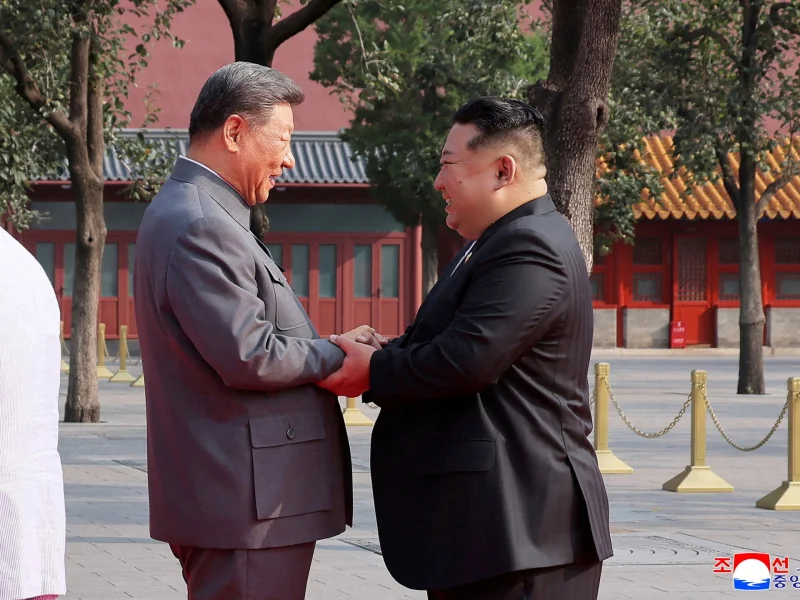
Chinese President Xi Jinping is in Pyongyang on Monday to meet Kim Jong Un, making his first trip to North Korea in seven years and putting Beijing back at the center of a relationship that has shifted as Moscow’s ties with Pyongyang have deepened. The visit is Xi’s first to the North Korean capital since 2019.
For readers wondering why this matters now, the answer is in how rarely Xi has been traveling and how much the regional balance has changed. He last met Kim in Beijing a year ago at a military parade marking 80 years since Japan surrendered unconditionally to the Allied forces, but Monday’s trip is different: it is Xi who is crossing the border, not the other way around. One analyst, William Yang, said the move shows the level of significance China attaches to the trip.
That significance is clearer when set against Xi’s broader travel pattern. Between 2013 and 2019, he averaged about 14 trips a year. Between 2022 and 2025, that fell to about six a year. He made one overseas trip in 2020 and none in 2021, a stretch that underscored how selective his foreign travel has become. Yang said the growing trend is foreign leaders heading to Beijing to meet with him, which makes a trip to Pyongyang stand out even more.
China has reasons to want a hand on the wheel in North Korea. Since Russia’s invasion of Ukraine in 2022, Pyongyang has provided Moscow with critical weapons, artillery and manpower. A South Korean institute estimated that since 2023 Moscow has paid North Korea as much as $14.4bn for troop deployments and exports of artillery, shells, and guided and ballistic missiles, with between $580m and $1.5bn of that possibly delivered in goods. That kind of flow has tightened North Korea’s reliance on Moscow just as Beijing tries to preserve its own leverage.
Lee Sang Yong said Beijing likely wants to reassert its influence over North Korea and prevent Pyongyang from leaning too heavily toward Moscow. China still shares a mutual defence treaty with North Korea, but it is also wary of Russia’s growing influence over the country. North Korea has traditionally depended heavily on China for as much as 95 percent of its trade, according to a 2022 estimate from the National Committee on North Korea, which helps explain why this visit carries more weight than a routine diplomatic stop.
What Beijing is bringing to Pyongyang remains unclear, but Rachel Minyoung Lee said offering North Korea economic incentives may be part of the plan. For now, the main fact is the trip itself: Xi has chosen Pyongyang for a meeting that signals China is trying to reassert itself before Russia’s hold on North Korea becomes even harder to dislodge.
