


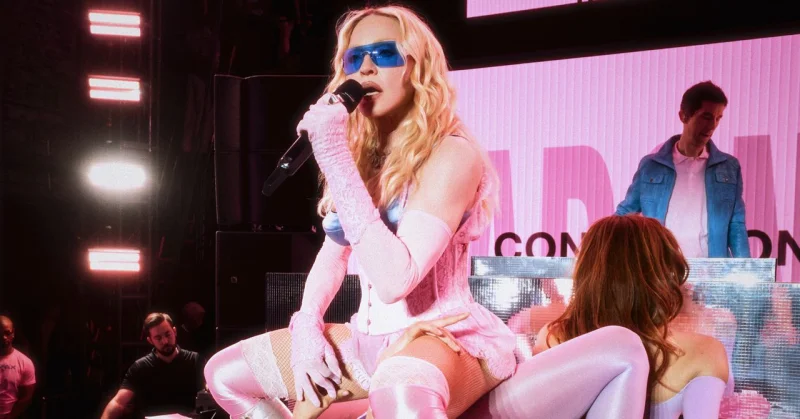
Madonna turned Times Square into a live pop set on Thursday, stepping out for a 20-minute surprise concert built around Grindr’s latest marketing takeover. She mixed songs from her upcoming album, Confessions on a Dancefloor: Part II, with a trio of hits from 2005’s Confessions on a Dancefloor, including “Hung Up,” as dancers flashed through the crowd and she appeared from one of the giant screens on a spinning stage suspended above the street.
The performance landed squarely in the middle of a campaign designed to push Madonna to Grindr’s 15 million average monthly users, while also throwing her music into one of New York’s busiest public spaces. For a brand built on discovery and for an artist long tied to club culture, the pairing was meant to feel immediate, visible and a little mischievous — the kind of spectacle that can travel far beyond the block where it happens.
That is also why the event is drawing attention now. On April 24, Grindr users opening the app heard Madonna say, “Hello, it’s mother,” and the app’s homepage has been steering people toward either a Grindr-exclusive vinyl or a livestream of the Times Square show. A pink icon even marked Madonna as “0 feet away,” while her albums appeared as tags alongside options for kinks, hobbies and tribes, turning the promotion into something closer to an in-app takeover than a standard album plug.
George Arison, Grindr’s chief executive, said users spend an hour a day on the app, which helps explain why the company has been leaning into music campaigns. It had already replaced its message notification sound with Christina Aguilera’s “Come on Over Baby (All I Want Is You)” before her September appearance headlining the Portola Music Festival in San Francisco, and it has also used pop-up videos and exclusive clips from artists including Hilary Duff, Troye Sivan and Slayyyter. The Madonna push is bigger, but it follows a path Grindr has been testing for some time.
The first outreach nearly fell apart before it started. Guy Oseary reached out to Grindr last fall, and Arison thought the first email from a Gmail account was a scam. Oseary later came to Grindr’s headquarters in San Francisco to play the music and start planning, and he said Madonna “wanted to get back to the basics.” He also described the campaign as authentic and organic, with the rollout beginning in small circles: the first single, “Bring Your Love,” went first to two LGBTQ clubs, then to iHeart’s PRIDE Radio, before spreading more widely.
That sequence matters because Madonna’s public image has always been tied to the clubs and communities this campaign is aimed at. Oseary, who started working with her at Maverick in 1992, framed the rollout as a way to support that audience without treating it like an afterthought. Madonna also played up that connection in a video roundtable with Bob the Drag Queen and Jeremy O. Harris, where she discussed “hole pics” and joked that JFK Jr. was her best “dick down.”
For now, the Times Square appearance gives Madonna a fresh burst of visibility and gives Grindr a marketing stunt that actually happened in front of a crowd rather than inside a feed. What it does not answer is the bigger question behind the spectacle: whether the show and the app tie-in will move album sales, change listening habits or bring in lasting use beyond the night’s noise.
