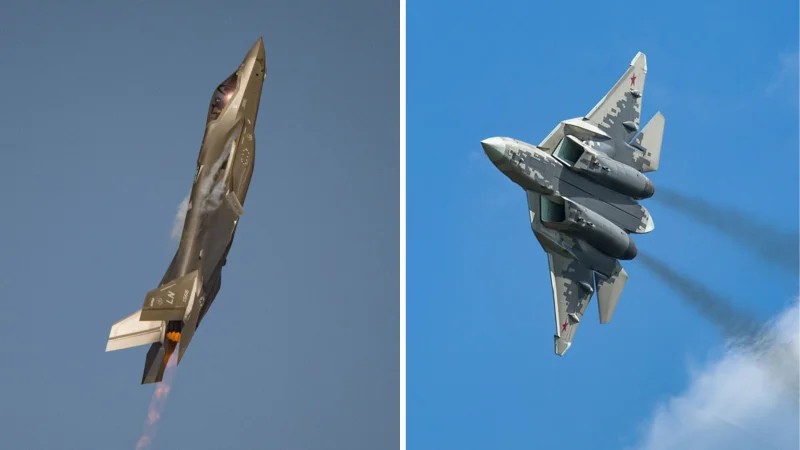
Interesting Engineering has published a fresh comparison of the F-35 Lightning II and the Su-57 Felon, two of the world’s most advanced combat aircraft, and the result is a familiar split: one jet is built to be seen as little as possible, while the other is built to move fast and fight hard. Both are fifth-generation stealth fighters designed to carry weapons internally, evade radar and hit targets across multiple domains, but their priorities diverge sharply.
That contrast is why readers are searching Rostec Su-57 stealth capabilities now. The F-35 was designed from the outset around stealth, networking and battlefield awareness, while the Su-57 leans more heavily on speed, maneuverability and long-range air combat. In practical terms, that means the American jet is discussed less as a knife fighter and more as an information hub in the sky, while the Russian aircraft is presented as a more agile platform built to contest airspace on different terms.
The F-35’s low observability is not an accident of shape but the result of a design philosophy that runs through the airframe, engine inlets, weapons bays and radar-absorbent coatings. Open-source estimates put its radar cross-section at roughly 0.001 to 0.005 square meters, a figure that places it among the hardest modern fighters to detect. The Su-57 also uses stealth shaping and radar-absorbing materials, and it is harder to spot than older Russian fighters such as the Su-35, but most estimates still place its radar cross-section well above the F-35’s.
The bigger gap appears in what the pilots see once they are airborne. The F-35 combines data from its AN/APG-81 AESA radar, Electro-Optical Targeting System and Distributed Aperture System into a single fused picture, letting pilots absorb the battlefield without sorting through separate sensor feeds by hand. That sensor-fusion capability has often been described by pilots as the aircraft’s greatest strength, and most analysts say it is why the F-35 currently sets the benchmark for situational awareness among operational fighter aircraft.
The Su-57 is not blind. It carries the N036 Byelka AESA radar and multiple infrared search-and-track systems, and it is built to work as a capable fifth-generation fighter. The problem is that much less is known about how mature its sensor-fusion architecture is, and that uncertainty matters as much as any claimed performance figure. A jet that emphasizes speed and maneuverability can still be formidable, but if its stealth and awareness lag behind the F-35’s, it is fighting from a different starting point.
That leaves the central question where these comparisons usually end: open-source estimates can sketch the differences, but they do not settle how the two aircraft would perform against each other in real combat. For now, the evidence points to a clear divide. The F-35 remains the stealthier platform and the standard-setter for situational awareness, while the Su-57’s strengths are more visible in speed, agility and long-range air combat than in low observability.