


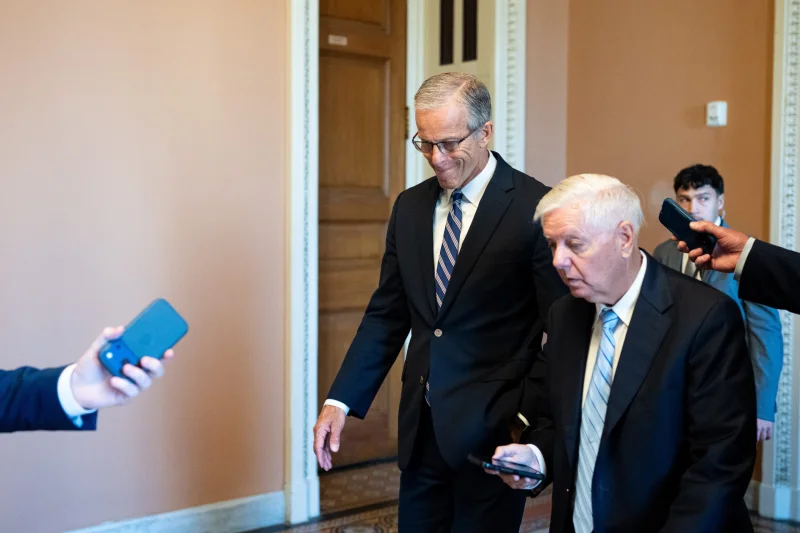
Four Senate Republicans helped block another attempt to move the Save Act through the Senate on Thursday night, denying Republicans the 60 votes they needed to attach President Donald Trump’s voter ID and election integrity bill to a budget reconciliation package.
The failed vote marked the second time Republicans tried to graft the Safeguarding American Voter Eligibility America Act onto a nearly $70 billion package aimed at funding Immigration and Customs Enforcement and Border Patrol. Susan Collins, Lisa Murkowski, Mitch McConnell and Thom Tillis broke ranks and joined every Democrat to stop it, leaving the measure short of the threshold needed to advance.
The vote mattered now because Republicans had made the Save Act a test case for whether they could move one of Trump’s marquee elections bills through a Senate that has already shown little appetite for it. Just over a month ago, a similar proposal was defeated on a bipartisan basis, and Thursday’s outcome showed that opposition has not softened.

Lindsey Graham pressed Democrats to reject the amendment, arguing that requiring identification was the only sensible position and saying it “just makes cheating easier.” He also asked, “Who wants a noncitizen voting in our election if you're against that, that makes me wonder,” and broadened the pitch by tying the fight to transgender issues and minors seeking to transition, a sign of how Republicans are bundling social issues into the wider border and elections fight.
Alex Padilla pushed back on that framing, saying that just over a month ago, a similar proposal was defeated on a bipartisan basis. That line captured the problem for Republicans: even when they attach the bill to a must-pass spending fight and a major immigration package, they still cannot assemble enough support in the upper chamber to move it forward.
What happens next is unclear. Republicans have now tried twice to use budget reconciliation as a path for the Save Act, and the Senate result suggests they still lack a route around unanimous Democratic resistance and the defections inside their own conference. For now, the bill remains stuck where it has been for weeks: short of the votes needed to move.
