


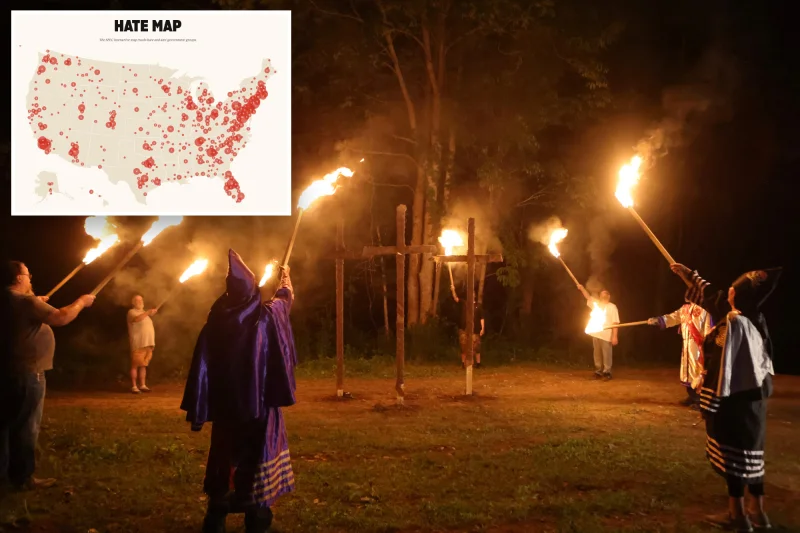
The Justice Department filed a superseding indictment Tuesday in federal court in Montgomery, Alabama, accusing the Southern Poverty Law Center of paying white nationalists and Ku Klux Klan members thousands of dollars in donor money to stay inside hate groups. Prosecutors said the payments included reimbursements for cross-burning events and other extremist activity.
The new filing sharpens a case that now centers on who was paid, how much was paid and what the money was used for. Two Klan members identified as F-31 and F-32, who came to the SPLC in 2010 saying they feared for their safety and wanted out of the group, were allegedly paid $1,200 a month plus expenses through a shell company called Rare Books Warehouse to remain in the Klan.
Prosecutors said some of that money helped recruit new members and make white robes, while court documents say the pair were reimbursed for every cost tied to cross-burning events, including the wood and fuel used. The indictment also says expenses for rallies, the creation of new chapters, racist paraphernalia and other extremist literature were covered, and that the nonprofit used fictitious companies to conceal from donors a total of $4.1 million in payments to field sources between 2014 and 2023.
The filing names eight informants, including a Ku Klux Klan Imperial Wizard and a leader of the chat group that organized the 2017 Unite the Right rally in Charlottesville, Virginia. One source tied to that rally allegedly received $270,000 from 2015 to 2023, and another allegedly got $1.2 million for activities that included stealing 25 boxes of documents from the neo-Nazi National Alliance.
The SPLC’s lawyers pushed back in court papers, saying the confidential informants provided helpful information that was later passed to law enforcement. They also said the Justice Department knows those sources helped put violent extremists in jail, including a member of Atomwaffen Division who intended a major terrorist attack against Las Vegas. That defense cuts against the prosecutors’ version of events, which says donor money was used to fuel extremist activity rather than gather intelligence on it.
What the Justice Department still has to prove is whether the payments and reimbursements were a covert way to support hate groups or the price of penetrating them. The answer will determine whether Tuesday’s indictment becomes a fraud case about donor deception or a broader test of how far undercover work can go before it starts looking like the thing it was meant to stop.
