


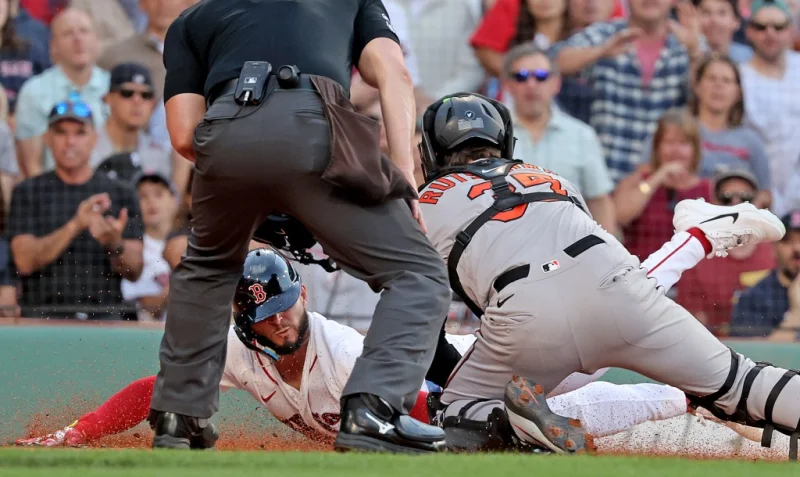
Chad Epperson stepped into fair territory while waving Wilyer Abreu home Wednesday night, a rare move that turned into a rules debate after the Red Sox beat the Orioles. The play came in the bottom of the third inning, when Abreu was sent from third on Willson Contreras’ double down the left-field line.
The run was initially ruled safe, then overturned on review. What made the sequence linger was not only the close play at the plate but Epperson’s position on the infield grass, where coaches are usually expected to stay inside the box unless the play demands otherwise. It was the kind of moment that can disappear in a box score and still send people hunting for the rule book by the time the game ends.
That search lands on MLB Rule 5.03(c), which says base coaches must remain inside the coach’s box unless there is a play at their base, though a coach can leave the box to signal a runner to slide, advance or return so long as he does not interfere with the play. An MLB spokesperson told the Herald there is no automatic penalty for a coach who moves into fair territory, but interference can still be called if an umpire decides the coach affected the defense’s ability to make a play.
Chad Tracy said the Red Sox believed from the start that Epperson was in the clear. “Incorrect. Well, he was told that, but that is incorrect and it’s since been corrected,” Tracy said of the explanation given after the game. “You are allowed to do that so long as you do not interfere with the play in any way.”
Tracy said he has seen third base coaches move that way before, including at Fenway Park, where the seats jut out nearly into fair territory down the left-field line. He said that shape can make it impossible for a coach at third to track a ball hit into the corner, and he pointed to JetBlue Park in Fort Myers as another place with the same basic dimensions. “I remember the first time I stepped foot in JetBlue my first year here and I was coaching third in an inter squad game and a ball went down there and I was like ‘I can’t see the ball,'” he said. “So if it stays and hugs in there you cannot see it, you have to get yourself basically in fair territory to get a look at where it’s at.”
That is where the argument sharpens. Orioles manager Craig Albernaz said umpires explained Epperson could be ejected if he crossed into fair territory again, while Tracy said that was not right. He added that the real issue would be whether a coach got in the way of a cutoff man or blocked a fielder’s route to the ball. “I guess you could,” Tracy said. “But I think it’s more involving if you’re in the way of a cutoff man or if (Coby) Mayo trips over your feet or he’s feeling like he can’t get into position, that would be where they would rule it.”
For the Red Sox, the practical answer is the one that mattered Wednesday night: Epperson’s move was not an automatic violation, and the only call that would have changed things would have been interference. The next time a coach edges into fair territory to see a ball hugging the line, the real question will be whether an umpire decides he changed the play or just found a better angle.
