


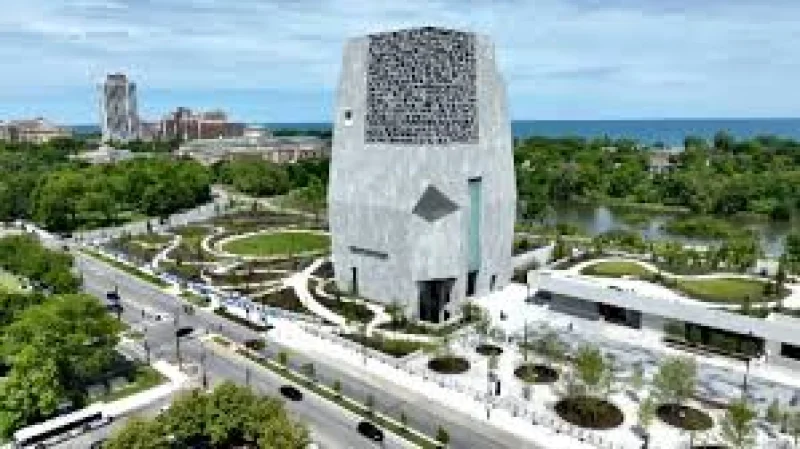
The Obama Presidential Center is about to open on Chicago’s South Side, bringing to life an $850 million campus that rises 70 metres above a low-income neighborhood and has already become one of the most talked-about presidential memorials in the country. Designed as a mostly windowless complex on a 19-acre site, it is the largest and most audacious presidential project of its kind.
For people searching for the Obama Presidential Library now, the reason is simple: the building is no longer a proposal or a model, but a finished presence about to enter the city’s skyline. The design competition was won in 2016 by Tod Williams Billie Tsien Architects, and the project has been watched for years as a test of how a modern presidential monument would look in a place far from the polished campuses and marble facades usually associated with power.
Billie Tsien, one of the architects behind the project, said the idea was a beacon. She described the form as four hands coming together to protect a flame from the wind, a symbol meant to suggest shelter rather than force. Tsien also said President Barack Obama was very hands on with the design, and that he talked a lot about his love of Brâncuși, the sculptor whose spare forms influenced the project’s severe geometry.

That is not how everyone reads it. The building’s fortified shell and small chamfered openings give it a harder edge than the language of hope suggests, and the result is a structure some compare to a menacing sci-fi headquarters, a flak tower or even a Klingon prison. Its narrow apertures look less like windows than portals, the kind from where drones might be launched or lasers fired, which is a long way from the warm civic welcome most presidential centers are meant to project.
The contrast matters because presidential libraries have long been treated as secular temples, places where former presidents are turned into sites of pilgrimage. Franklin D. Roosevelt started the tradition in 1940 with a Dutch colonial library beside his grave in upstate New York, and the forms have shifted ever since through Lyndon B. Johnson’s brutalism, Ronald Reagan’s hacienda and Bill Clinton’s metallic box. On that lineage, Obama’s campus is the latest and biggest statement yet, and it towers over a part of Chicago that has not often been designed to be towered over.
What happens next is the real test. Once the doors open, the question will not be whether the center is visible — it already is — but whether a project built to read as a beacon can feel that way to the neighborhood living in its shadow.
