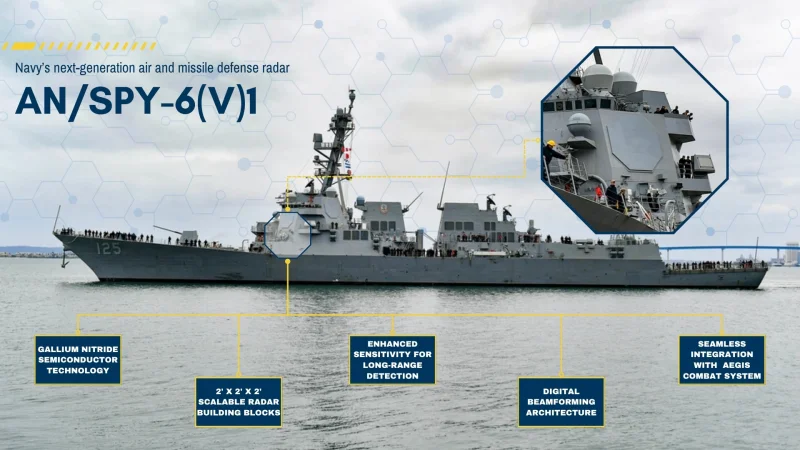
Raytheon won a $646 million option exercise in June 2025 to keep producing SPY-6(V) radar systems for the U.S. Navy, extending work on a program that has become central to the service’s air and missile defense plans. The award came from a March 2022 contract and keeps the radar line moving forward at a time when the Navy is still fitting the system across multiple ship types.
The timing matters because Raytheon said in June that 42 SPY-6 radars were already under contract for procurement, and the company later said the family is expected to equip at least 60 vessels. That makes the June award more than a paper exercise; it helps sustain production on a radar family that is moving from early fielding toward wider fleet use, including Arleigh Burke Flight III destroyers, Ford-class carriers and several other classes that use different SPY-6 variants. In another naval radar project, a separate pursuit of next-generation software has shown how quickly the technology stack around these systems is still evolving. Tornado Radar question lands as Maryland enters severe weather season
The SPY-6 line exists because the earlier SPY-3/SPY-4 Dual Band Radar did not replace AEGIS at acceptable cost, and Raytheon built SPY-6 from that earlier effort. The system now comes in four variants: SPY-6(V)1 for Flight III destroyers, SPY-6(V)2 for carriers and amphibious ships including Nimitz-class carriers, America-class Landing Helicopter Assault ships and San Antonio-class Landing Platform Dock ships, SPY-6(V)3 for Ford-class carriers, and SPY-6(V)4 for Flight IIA destroyers under a backfit effort. The company also said some Zumwalt-class and Wasp-class ships could use the EASR variant.
What the June contract did not spell out is just as important as what it did. It did not identify which ships were included in the option exercise, and speculation that SPY-6 will eventually equip Golden Fleet BBGN-class ships remains too uncertain to pin down. Raytheon later said more than 15 SPY-6 radars had already been delivered to the Navy, which suggests the program is moving from procurement to fleet installation, but the next concrete milestone is not identified in the award itself.
For now, the June deal mainly answers one question: production is still going. The harder question is how quickly the Navy turns those contracted radars into installations across the classes the service has already chosen, and the answer will come only when the next ship-specific delivery or modification is announced.