


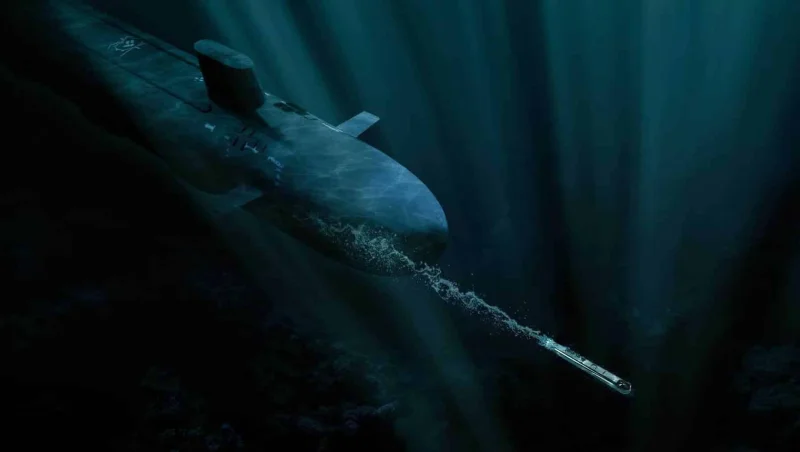
L3Harris is pushing ahead with production of its Iver4 900 autonomous undersea vehicle under a previously undisclosed Defense Innovation Unit effort aimed at giving the U.S. Navy’s attack submarine fleet a torpedo tube-launched and recovered drone. The system is being built to travel with multiple classes of attack submarines and act as an underwater loyal wingman, extending what a boat can see and do without putting sailors in the water.
JR Gear gave an update on the program’s status during the Sea Air Space 2026 Symposium in National Harbor, Maryland, saying the company is proving the system out with the Navy in exercises and iterating the concept through at-sea availabilities with Virginia-class submarines. He framed the appeal in blunt terms: submariners should be able to focus on the threat, not on flying, driving or steering another system.
The program matters now because the Navy is moving to expand its portfolio of launched effects, a shift meant to give each submarine more independent targeting and kill-chain capability. The Iver4 900 is one of several options being pitched for the service’s subsurface fleet, but it has already moved beyond paper concepts: contracts have been signed to deliver several vehicles to the fleet for evaluation and early operational use, and the vehicle is being exercised with the Navy as the design matures.
Gear described the drone as the kind of unmanned system that can take on the “dull, dirty and dangerous” work that would otherwise fall to sailors. As an organic sensor for a submarine, the Iver4 900 is being explored for mine warfare, forward intelligence gathering, seabed mapping and other classified missions. The company says the goal is to free up sailors from routine workload so they can concentrate on higher-priority tasks.
The hardware is meant to be flexible as well as autonomous. The Iver4 900 has swappable payloads along its side, in the nose and in the tail, with removable configurations that can carry sonar arrays, seabed mapping systems, minesweeping capabilities and other third-party platforms. Powered by lithium-ion batteries, it can operate independently of the submarine for 16 to 24 hours, and with a mission-minimal payload it can stay out for 40 hours on one charge.
It is also untethered, giving it extended-range operations for dozens of miles in any direction. That makes the vehicle more than a short-range accessory; it is being developed as a modular sensor and mission system that could help attack submarines push farther and see deeper without exposing the boat to unnecessary risk.
Gear did not elaborate on how the submarine would communicate with the AUV, leaving one of the most practical questions about the system unanswered. But the broader direction of the work is clear: the Navy is testing whether a small autonomous vehicle can become a regular part of an attack submarine’s toolkit, and L3Harris is already building toward that answer.
