


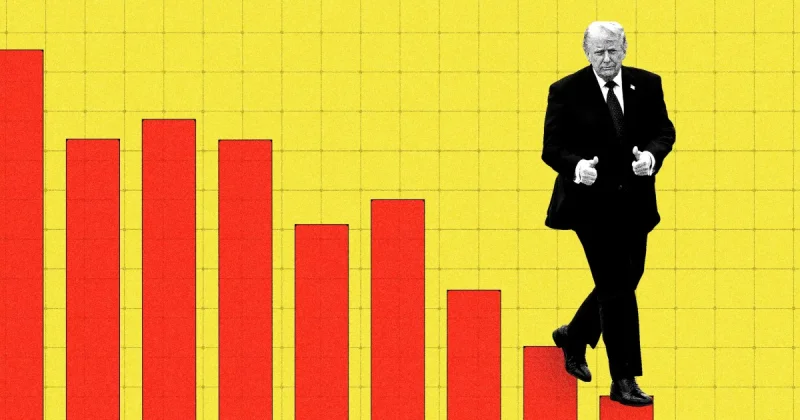
Donald Trump’s approval has sunk below zero even in Greater Appalachia, the region long treated as his ultimate stronghold. Updated regional estimates based on a May 18-19 poll put him at 42.8% approval there, another sign that his support is sliding across the map rather than holding in place.
The numbers come from G. Elliott Morris, who used a Strength in Numbers/Verasight poll fielded May 18 and 19 to build inferential approval estimates for each of the country’s 2,400 Public Use Microdata Areas, or PUMAs. Each area contains roughly 100,000 adults, giving Morris a way to compare Trump’s standing across the American Nations regions instead of treating the country as one flat average. By that measure, Trump’s federation-wide support fell from minus 18% in January to minus 23% in the new estimates.
That decline matters because the erosion is not confined to Trump’s weakest territory. Morris had already shown after his January 14-20 national poll that Trump had lost ground almost everywhere outside Greater Appalachia and the eastern parts of the Far West compared with the 2024 election. The new May estimates go further. Trump is now under 35% approval in the Midlands, at 22.3% in Hawaii, at 38.1% in the Deep South and at 38.5% in the Far West. In the places that were supposed to be steadier, the floor has gone lower.

Morris also said Trump has very few supporters in communitarian regions, ranging from under 35% approval in the Midlands to just 22.3% in Hawaii, part of the Greater Polynesian cultural space. That line captures the pattern running through the new map: the president’s weakest numbers are in places that rarely favored him, but the more striking break is that support is falling again in areas that had once been far friendlier.
The friction is in the geography. Trump was already underwater across much of the Deep South and throughout the Lower Rio Grande Valley in El Norte after the earlier January poll, yet the May estimates show him dropping further there and in Greater Appalachia, too. That is hard to square with the 2024 election result, when he won the Far West and Deep South by double digits. The regional model points to a presidency losing altitude even where it once seemed safest.
What comes next is another test of whether this is a temporary dip or a deeper break in Trump’s coalition. Morris has not set out a next poll date, and there is no indication yet of what might arrest the slide. For now, the latest United States presidential approval rating data show a president whose support is no longer just weak at the margins; it is deteriorating in the very regions that once made his map look durable.
