


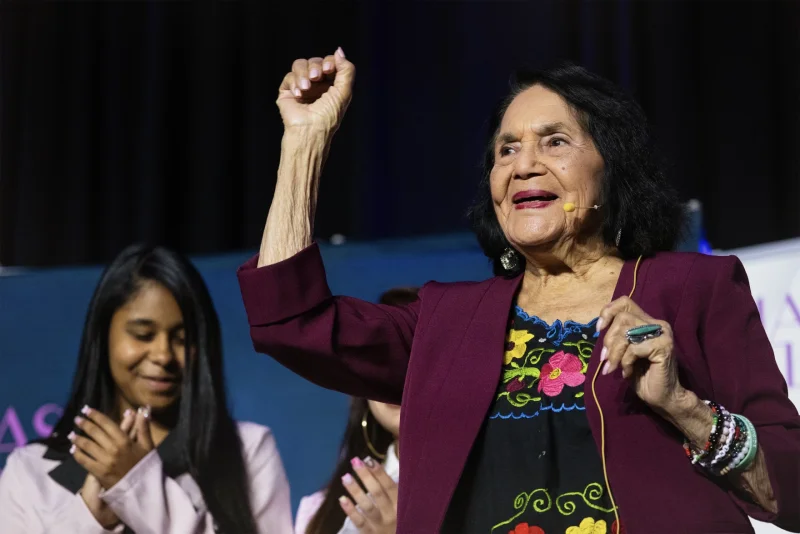
Dolores Huerta came to Hartford this week to accept the Living Legend Award at the 23rd annual Latinas in Leadership Symposium, bringing more than seven decades of labor and civil rights activism to a room filled with nearly 800 Latinas and their allies from across the state and region.
The 96-year-old Huerta was introduced in a fireside chat moderated by Connecticut Public’s Rachel Iacovone, and the crowd heard from one of the founders of United Farm Workers of America at a moment when her name remains tied to one of the most enduring slogans in modern American activism.
That slogan, “Sí se puede,” has been celebrated for decades, but Huerta traced it back to a fight against a specific barrier: an anti-boycott law in Arizona. She said the phrase came to her when United Farm Workers was trying to rally support, and she told organizers, “Sí se puede in Arizona.” They began clapping and repeating it. The line later traveled far beyond the labor struggles that first shaped it.
Huerta’s rise began in the 1960s, when United Farm Workers emerged as part of the mostly Chicano, or Mexican-American, civil rights movement. The union later pressed for better pay on the five-year Delano Grape Strike, and Huerta said similar fights continued in Florida, where farmworker-rights advocates have pushed the Fair Food Program’s auditing system and higher pay per piece of harvested produce to curb wage theft, abuse and dangerous working conditions.
That history also reached into presidential politics. In 2007, Barack Obama leaned heavily into an English version of Huerta’s slogan, “Yes, we can,” during his first run for president. Huerta said Obama told her, “I stole your slogan,” and she answered, “Yes, you did.” The exchange captured how a phrase born in a labor struggle became part of the national political lexicon.
What Huerta brought to Hartford was not just a slogan people recognize, but a reminder that the slogan came from resistance, not symbolism. Her story landed in a city auditorium full of women and allies who were being asked, in effect, to treat civic engagement the way she always has: as work that outlasts applause, and as something that has to be taken up again long after the speech is over.
