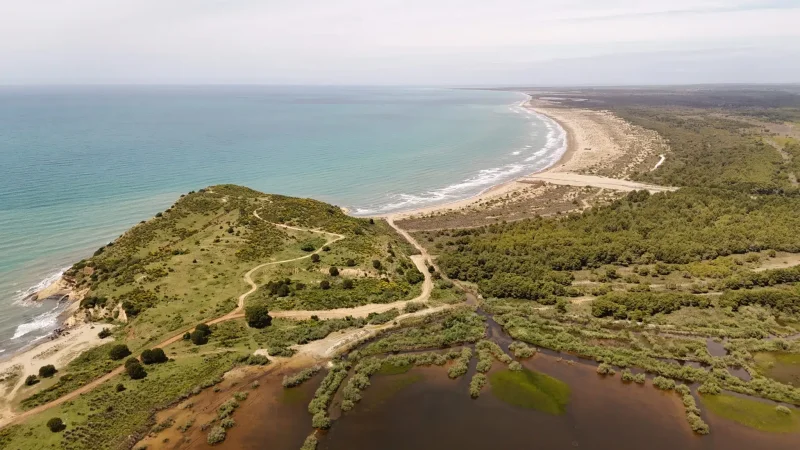
Heavy machinery has been tearing through Albania’s Pishë Poro–Narta Protected Area since late April, carving into a coastal landscape that environmental groups say should have remained off-limits. The work has gone ahead without permits and without an environmental impact assessment, even as barbed wire now blocks public access to parts of the shoreline.
The damage has become a flashpoint because the area sits inside the Vjosa–Narte Protected Landscape, part of the delta of the Vjosa, one of Europe’s last wild rivers. A luxury resort development backed by Jared Kushner has been planned for the same stretch of coast, and Prime Minister Edi Rama has said the construction is directly tied to that project.
For opponents, the scale of the assault is the point. BirdLife’s Albanian partner PPNEA has called it the worst destruction ever recorded in Albania’s protected areas, and said the work is unprecedented. The site shelters more than 70 endangered species and more than 200 bird species, including flamingos and Dalmatian pelicans, and lies on the Adriatic Flyway, a route used by migrating birds across the Mediterranean basin.

The environmental stakes do not stop on land. The surrounding waters are among the last Mediterranean refuges for the Mediterranean monk seal and a key nesting ground for the loggerhead sea turtle. Scientists say gravel has been dumped onto ancient sand dunes designated as Natural Monuments under Albanian law, and that repairing the damage could take hundreds of years. Construction has also blocked one of the two openings linking the Narta Lagoon to the sea, cutting tidal exchange with immediate consequences for fish, birds and the food chain.
That is where the government’s explanation has run into the ground. When questioned in parliament, it said the lagoon opening had been closed to build a road for environmental surveying, but what is visible at the site does not support that account. BirdLife International says the work is taking place in a protected coastal habitat while the state has given false explanations to lawmakers, a claim that has deepened public anger rather than quieted it.
The backlash has widened beyond the shoreline. Citizens protesting peacefully have been met with violence, and thousands have taken to the streets of Tirana. Anouk Puymartin, speaking out in defense of Vjosa-Narta, said barbed wire cannot silence people and that thousands had gathered in the capital to defend the area from destruction driven by private profit.
The fight over Pishë Poro–Narta now sits at the center of a larger test for Albania: whether protected areas can still be protected once a government has opened the door to resort construction. Puymartin warned that nature belongs to everyone, not a handful of investors, while PPNEA’s Aleksandr Trajçe said that by the time the law on protected areas is brought back into line with EU standards, very little may remain to protect.