


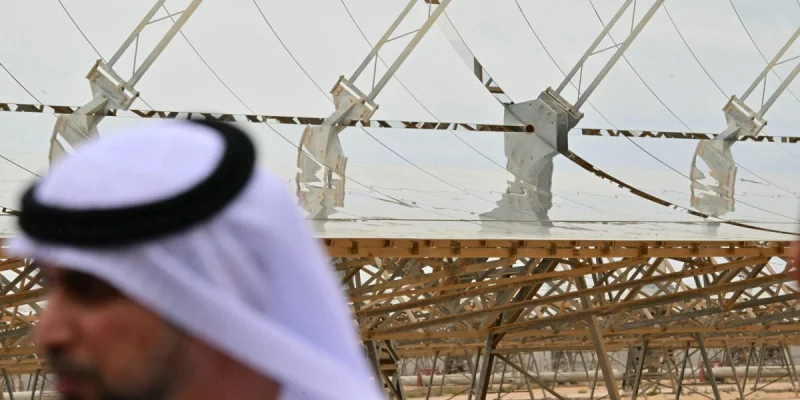
Iran’s blockade of the Strait of Hormuz has pushed Gulf oil producers to sharply curb output, while governments across the region rush to put more money into renewable energy projects overseas. The shift is unfolding as the U.S.-Israeli war with Iran enters its third month and keeps pressure on the world’s most important oil passage.
The stakes are immediate. The International Energy Agency says the conflict has caused the largest supply disruption in the history of the global oil market, and Gulf governments are responding by moving capital fast. In April, Masdar signed a binding $2.2 billion, 50/50 joint venture with France’s TotalEnergies that will merge their onshore renewable businesses in nine Asian countries. Soon after, the UAE decided to leave OPEC, a move that underscored how sharply its energy strategy is shifting.
Robin Mills, who has followed the region’s energy trade for years, described those projects as long-laid plans but said current events are speeding them up. He said Gulf countries are increasingly thinking about domestic energy security, and that the present environment is improving the case for overseas renewable portfolios because they are more diversified and strategic. The UAE, he said, also wants to monetize oil resources faster as it looks ahead to peak global demand and frees up more gas for its industrial and AI plans.
The money is already moving. In early May, Mubadala Investment Company took a significant minority stake in Power Factors, and this month it put $325 million into Orsted’s Hornsea 3 project. Hornsea 3 will join Hornsea 1 and 2 to form the world’s largest single offshore wind farm, with a combined capacity above 5 gigawatts. Masdar, meanwhile, said in January that its global renewable capacity had reached 65 GW, up from 51 GW in 2025, and it still aims to hit 100 GW by 2030 after investing $45 billion across six continents since 2006.
But the same war that is pulling Gulf capital toward foreign wind and solar is also making life harder at home. Data from Norway’s Rystad Energy showed Gulf solar PV imports collapsed in March, with UAE imports falling to 160 MW from 767 MW, a sign that the planned buildout of domestic renewable projects is under strain even as overseas deals accelerate. The UAE is still targeting oil production capacity of 5 million barrels per day by 2027, up from 3.4 million barrels per day in January 2026, which leaves the region trying to expand both its fossil-fuel and clean-energy ambitions at once. For now, the most important question is not whether Gulf states keep investing abroad; it is how long the blockade lasts and how much further output has to fall before the region’s energy map changes again.
