Rheinmetall won more than €1.9 billion in new orders in a single week, yet its shares still finished the week roughly a third below the high they reached last September. The gap between the contracts and the stock price was still there on Friday, when the shares closed at €1,291.60 after a 5.75% weekly gain.
That is why investors were watching Monday closely for any reaction to the Romanian deal. The market has a fresh run of orders to digest, but it has also spent months treating the defence group as a company with more business than it can easily turn into output.
The biggest single piece of the week came on 29 May, when Romania’s defence ministry signed procurement contracts under the EU’s SAFE programme, including a €920 million deal with NVL B.V. & Co. KG. The package covers two maritime patrol vessels and two diver-intervention boats, and Rheinmetall’s newly acquired shipbuilder sits at the centre of it after the group bought NVL on 1 March 2026. Romanian state news agency AGERPRES reported the deal.
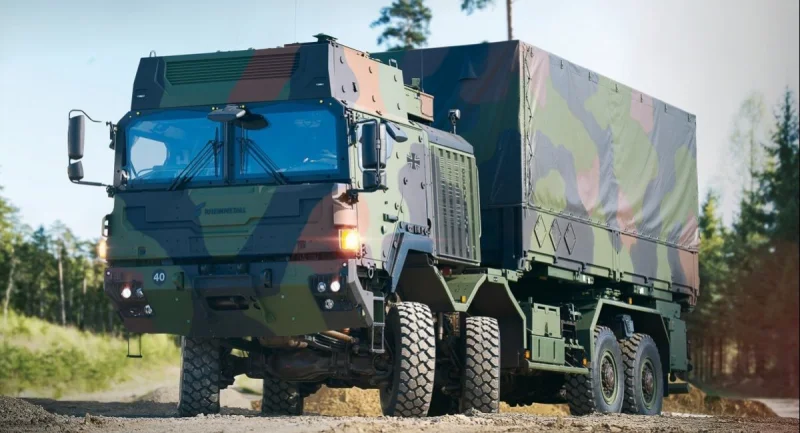
Germany added to the tally days later, with the Bundeswehr placing two separate orders that stretched Rheinmetall’s backlog even further. One was for a six-figure quantity of LLM-VarioRay laser-light modules, a contract worth hundreds of millions of euros and due to run through to 2032. The other was a framework agreement for more than 2,000 military transport vehicles worth just over €1 billion, with the first deliveries set for the first half of 2026.
The week’s ordering pace came as the company’s stock chart told a different story. Even after Friday’s rise, the shares were still down more than 30% from the €1,995 peak set in late September 2025. The relative strength index stood at 84, a level that suggests the shares were running hot, while €1,300 was seen as the next resistance level.
That mismatch is not about a lack of demand. It is about capacity. Rheinmetall has told steelmakers such as Salzgitter and Dillinger that it needs higher delivery volumes for armour plate, and its own steel consumption has doubled in two years. Daniela Cavallo, Volkswagen’s works council chief, has also signalled openness to using the Osnabrück plant for military vehicles once Porsche production ends there in 2026, a reminder that the company’s next constraint may be industrial space as much as incoming orders.
Investors have reason to keep watching. A planned package of up to 1,000 Leopard 2 main battle tanks and 2,500 GTK Boxer wheeled armoured vehicles, estimated at as much as €25 billion and to be carried out jointly with KNDS, would deepen the backlog further if it moves ahead. For now, the stock is still waiting for the market to believe that Rheinmetall can turn record demand into deliveries fast enough to justify a move back toward its previous high.