


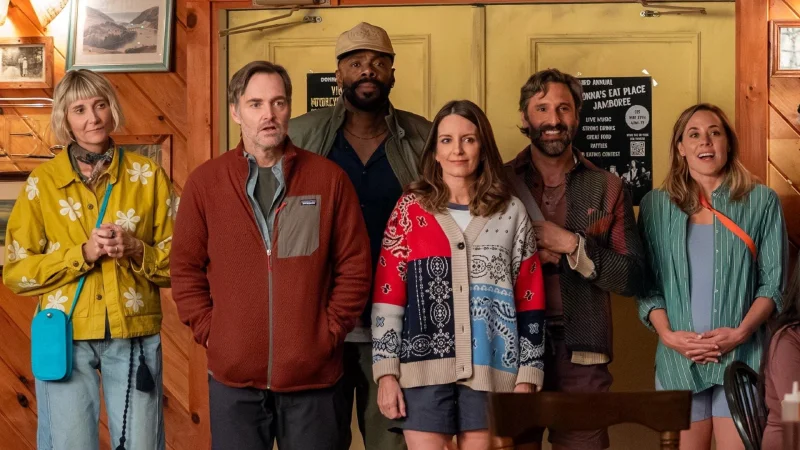
The Four Seasons season two has been greeted as even more fantastic than the first, a sharp thumbs-up for Tina Fey’s zippy 2020s update of the 1980s film. The verdict matters because this is a midlife comedy drama built on grief, long-term relationships and a very deliberate holiday structure, and the new season leans harder into all three.
That helps explain why people are looking for dear england today too: they are hunting for the kind of character-driven TV that can still feel alive in a crowded streaming field. Co-created and written by Fey, Tracey Wigfield and Lang Fisher, the series returns with its three couples reshaped by Nick’s death at the end of season one, and the review’s central claim is simple enough — the follow-up lands better than the first.
The season’s spring stretch shows why. The grief-stricken sextet go on an upstate hike to scatter Nick’s ashes from his favourite mountain, only for the first attempt to be stopped by a Brownies group. On the second try, everyone hates each other and Danny has forgotten the ashes. By the third, an active manhunt traps them in a retro motel overnight, in a town so dismal that, the reviewer jokes, Tracy Chapman sped away from it.
That set-up could easily have become a rigid machine, and the review does not pretend otherwise. It praises the comedy as brilliant, but it also notes the show’s structural device, with four fancy holidays spread across the seasons and two gag-packed episodes given to each. In one headline, the series is even described as remaining in limbo. The point is not that the shape disappears; it is that the shape keeps threatening to show through, even when the jokes are landing hard enough to prompt laughter like a rewatch of 30 Rock.
Summer pushes the characters into stranger, warmer territory. Ginny has given birth, Danny and Claude want a baby, and Jack has found a man friend to have beach play dates with. Kate, played by Fey, cannot believe it: “I didn’t think middle-aged straight men could make new friends!” Jack, meanwhile, is still the uptight softie in a marriage that the show now calls “freeballing,” its phrase for Kate and Jack’s decision to grow apart on purpose.
Anne gets the season’s most off-kilter emotional arc. Nick’s ex-wife is living with Ginny, the much younger woman he left her for, and by summer there is a baby in the mix as well. Anne says, “Ladies aren’t supposed to be friends with the woman their dead husband left them for,” and Kate’s answer — “You’re right,” followed by “There is no Beyoncé song about that” — lands because it sounds like the only sane response in the room. Anne is so besotted with her new role that she is even testing Ginny’s breast pump on her own nipple, a detail that captures the show’s taste for tenderness that arrives dressed as chaos.
The best scenes, though, are still the ones between Danny and Claude, whose bickering is described as particularly funny, moving and sensitively wrought. That is where the season seems to escape its own design: not by ignoring the framework, but by filling it with people who feel bruised, vain and affectionate in ways a plot outline cannot quite contain. Big Thanksgiving ends with Jack kicking the turkey down the stairs and twisting his ankle, while Little Thanksgiving jumps back to the Covid pandemic, when Steve was alive. The verdict is not that the series has solved every problem. It is that season two is strong enough to make its limits part of the pleasure, and to leave the question hanging over its future not whether it works, but how long it can keep turning the same polished shape into something this sharp.
