


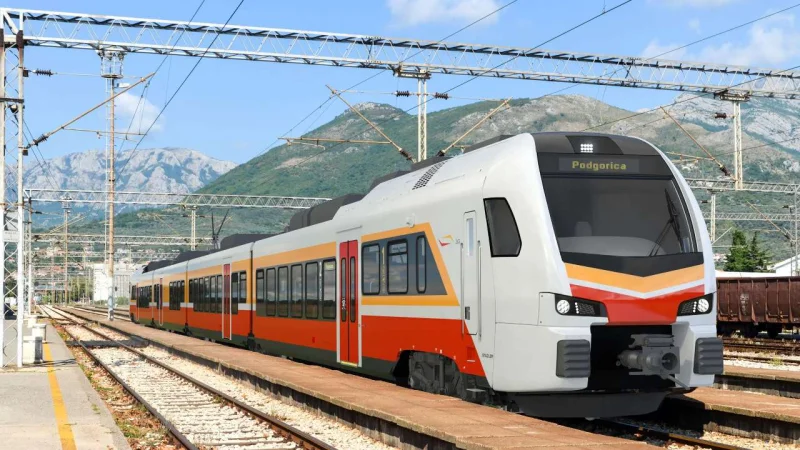
Stadler has signed a contract with Montenegro’s passenger rail operator to supply three four-car FLIRT electric multiple units, a deal that moves the Balkan country a step closer to a modernised rail fleet. The trains are intended to carry passengers more comfortably and safely, while also giving rail travel a stronger role in daily transport.
The order matters now because it is tied to a concrete upgrade for a small country that sits on the Adriatic Sea and has fewer than a million people. Stadler said the new units will make public transport more attractive and will serve as a visible sign of progress, European integration and regional connectivity, all ideas that carry weight in montenegro at a moment when cross-border rail links remain a practical test as much as a political one.
Stadler said the trains will significantly modernise passenger rail transport in Montenegro. The company also said the exterior design draws on the country’s national identity, using red and gold, and that the units will offer higher standards of comfort and safety than the stock they are meant to replace. Montenegro is receiving funding from the European Bank for Reconstruction and Development to buy the new trains, underlining that the purchase is part of a broader push to improve the system rather than a one-off purchase.
The contract also points to a bigger operational ambition. The FLIRT platform is already in service in several European countries, including Serbia, Slovenia and Austria, and Stadler has been selling the trains widely across the continent, with orders also in Lithuania, the Netherlands and Poland. The Montenegro units will be very similar to those already running in Serbia, and that similarity is what is supposed to allow them to cross the border between the two countries for the first time.
That cross-border promise is the part that still leaves the main question hanging: the companies have not said when the trains will enter service, and they have not laid out what still needs to be settled before passengers can actually ride them into Serbia. The contract is a clear signal of intent, but the practical work between signature and first passenger journey has not been spelled out.
Stadler originally developed FLIRT for the Swiss Federal Railways and delivered the first units in 2004, turning the model into one of the company’s most established products. For Montenegro, the new order is less about the brand itself than what comes next: whether the trains arrive on schedule, and whether the promised cross-border service becomes a working link rather than only a design feature on paper.
