


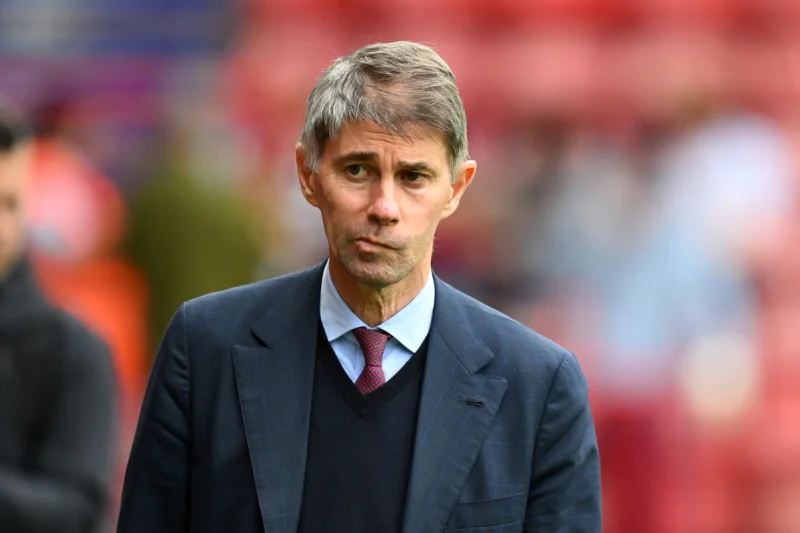
AS Roma and sporting director Frederic Massara have mutually agreed to end their working relationship, bringing his one-season spell in charge of the club’s recruitment and football planning to a close. The club said Massara’s departure came after he helped lay part of the groundwork for a campaign that ended with qualification for the next UEFA Champions League.
Massara joined Roma ahead of the 2025-26 season, and his exit now adds another change to a sporting structure that has been moving for months. The timing matters because the club is trying to build around Champions League football, and continuity in the front office is usually one of the first things that gets tested when results raise expectations.
Roma thanked Massara for his “professionalism, dedication, and contribution throughout the season,” and said that, thanks in part to his work, it had achieved an important objective by reaching the next edition of Europe’s top club competition. It also wished him well in his future professional endeavors, making clear the split was formal but not hostile in tone.
Massara, for his part, said he wanted to thank the ownership for giving him “the opportunity to return to work in an environment to which I am particularly attached.” He added that the club had built “further foundations for a successful future” over the year and wished the wider AS Roma family success in reaching new milestones. The phrasing matched the kind of careful farewell that often follows a clean break, even when the timing is awkward.
There was, though, a more complicated backdrop to the change. Reports in Italy had said Massara and Claudio Ranieri never truly saw eye-to-eye with head coach Gian Piero Gasperini, even as Roma placed full confidence in Gasperini. Ranieri, who had already left the club before Massara’s departure, had been part of a chain of departures that left the sporting side without two familiar figures in quick succession.
Roma had first decided to part company with senior advisor Ranieri, and Massara later followed him out of the door. That leaves the club with a sporting leadership vacancy just as it is trying to turn a Champions League return into something more permanent, and the next appointment will say as much about Roma’s direction as the departure itself. The club has not yet confirmed who will replace Massara.
If Roma can move quickly, the change may be read as a reset rather than a setback. If it cannot, the exit of a sporting director after only one season will become part of a larger question about how stable the club’s new hierarchy really is.
