


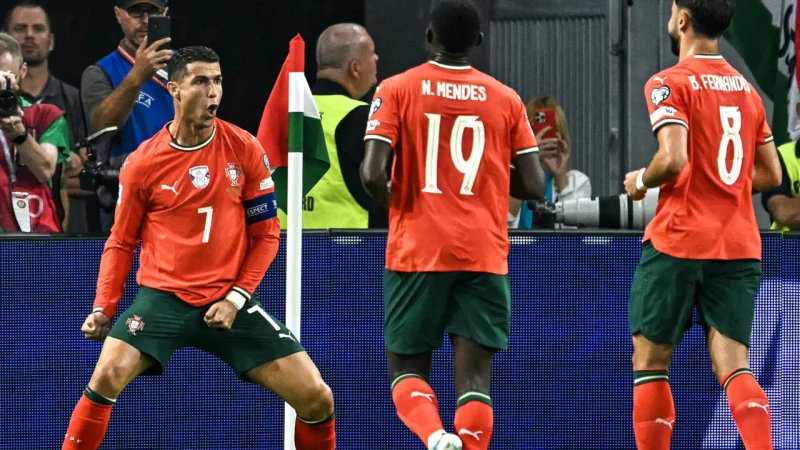
Cristiano Ronaldo will go to his sixth FIFA World Cup at 41, and the question around him is no longer whether he belongs on the stage. It is whether Portugal can give him enough time, and enough goals, to turn an already remarkable career into one more run at the Golden Boot.
That search has started early because Ronaldo is still being discussed as a contender, even if prediction markets have him well behind Kylian Mbappé and Harry Kane. He has scored in five different World Cups and has eight goals overall, but he has never managed more than four in a single edition, a ceiling that makes this tournament feel both familiar and difficult.
His best World Cup came in Russia in 2018, when three of his four goals arrived in one match against Spain. Four years later in Qatar, he scored once from the penalty spot before Portugal lost to Morocco in the quarter-finals. Those results matter because they show the pattern that has followed him for years: the goals come, but not usually in the volume needed to chase the tournament’s top scorer.
The history of the award is not on his side. Only one of the last 10 Golden Boot winners failed to reach the quarter-finals, Russia’s Oleg Salenko in 1994, while more recent winners have tended to come from teams that stayed alive deep into the knockout rounds. Mbappé scored eight goals in 2022 as France reached the final. Harry Kane scored six in 2018 and England got to the semi-finals. James Rodríguez scored six in 2014 and Colombia reached the last eight. Ronaldo’s own career best at a major international tournament is five goals at Euro 2020, where he won the Golden Boot on the assist tiebreaker over Patrik Schick.
Portugal’s route makes the task harder still. Roberto Martínez’s 27-man squad plays its three group fixtures in Houston and Miami, opening against the Democratic Republic of Congo on 17 June, then facing Uzbekistan on 23 June before finishing against Colombia on 27 June. Portugal should be heavy favorites against Congo and Uzbekistan and will likely dominate possession in those games, while Colombia brings attacking quality through Luis Díaz and James Rodríguez. The Miami match could decide seeding for the new Round of 32, and if Portugal tops the group it would likely open that stage against a third-placed side.
That is where the friction sits. Martínez has rotated his forward line during qualifying and recent friendlies against the USA and Mexico, and his 27-man squad includes Gonçalo Ramos, João Félix, Rafael Leão, Pedro Neto, Gonçalo Guedes and Francisco Conceição, several of whom can play centrally. If Portugal builds a comfortable lead against Congo or Uzbekistan, Ronaldo is likely to come off after 60 to 70 minutes. That is a sensible tournament plan, but it also means his cumulative minutes are unlikely to match Mbappé’s or Kane’s, even before Portugal’s progress is taken into account.
So Ronaldo arrives in the United States with the same contradiction that has followed him for years: still capable of deciding matches, still being discussed as if one more scoring burst is possible, but probably needing Portugal to keep winning and the minutes to keep coming. If the team reaches the latter stages, he has a path to the conversation; if it does not, the Golden Boot race will likely move on without him.
