


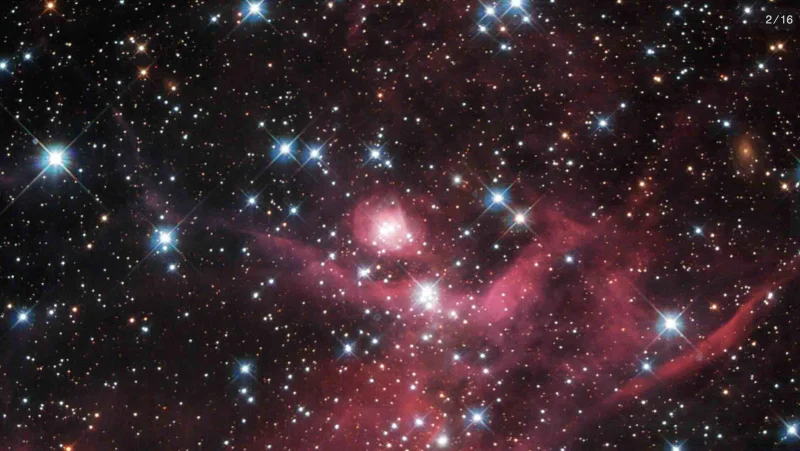
A star in the Large Magellanic Cloud flashed brighter for about one hour on the evening of December 18, 2019, and astronomers now think the culprit was an object they have nicknamed Phoebe. The brief brightening has become a live question in astronomy because the most likely explanation is gravitational microlensing, a passing object whose gravity bent the star’s light just enough to make it seem to surge.
The event has drawn fresh attention because it was so short. In survey data from a high cadence search of the Large Magellanic Cloud, Swinburne University astronomers in Melbourne spotted the signal only because they were looking often enough to catch something at the threshold of detectability. A recent paper set out three possible explanations for Phoebe: a free-floating planet in the Milky Way, a rogue planet from the Large Magellanic Cloud, or a primordial black hole.

Gravitational microlensing works like a lens made by gravity. When a compact object passes in front of a distant star, it can warp the light and briefly brighten the source without ever being seen directly. That is why the one-hour duration matters. Astronomers say such a short lensing event points to a relatively small object moving across the line of sight at speed.
The problem is that the light curve does not yet settle the question. The team believed Phoebe was roughly four times the mass of something the text leaves unnamed, but mass alone has not told researchers whether they are looking at a planet drifting through interstellar space, a planet born in another galaxy and now wandering, or something far stranger. Each possibility carries a different answer to the same puzzle: what passed in front of that star and how often objects like it may be hiding in plain sight.
For now, Phoebe is less a finished discovery than a test case. The one-hour flare on December 18, 2019 showed that brief microlensing events can reveal small, fast-moving objects that surveys might otherwise miss. The next step is to pin down which of the three explanations fits best, and whether this object was a free-floating planet, a rogue planet from the Large Magellanic Cloud, or a primordial black hole.
