


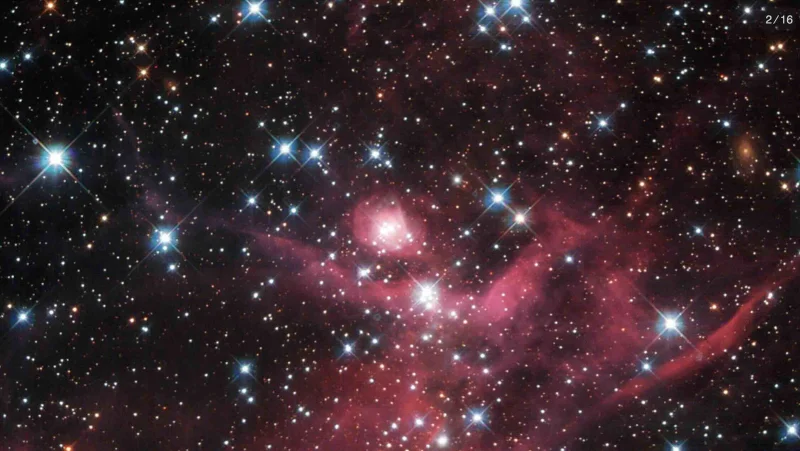
A star in the Large Magellanic Cloud brightened for about an hour on 18 December 2019, and the brief flare has become a test case for how little astronomers can still know from a single light curve. The object behind it was named Phoebe, and the event was so cleanly shaped that researchers read it as gravitational microlensing, with something passing in front of the star and bending its light toward Earth.
That is why the search for Phoebe is getting attention now. The brightening rose and fell smoothly and symmetrically, which is exactly the pattern that separates microlensing from an ordinary variable star, a flare, or an asteroid crossing the line of sight. A team from Swinburne University in Melbourne found the signal in a high cadence survey of the Large Magellanic Cloud, the Milky Way’s satellite galaxy, and the result was a one-off event seen only once, with the star never observed to vary again.
The measurements point to something astonishingly small. The team calculated Phoebe’s mass at about three times that of the Moon, a scale that sits far below the roughly five-times-the-Sun minimum for stellar black holes. That narrow flash is now the basis for a broad hunt: Phoebe could be a free-floating planet ejected from its home system long ago, a planet belonging to the Large Magellanic Cloud rather than the Milky Way, or a primordial black hole formed in the first fractions of a second after the Big Bang.
What makes the case harder to dismiss is the probability work behind it. Astronomers compared the chances that the lensing object belonged to Milky Way stars, Large Magellanic Cloud stars, or the dark matter halo between and around them, and the halo won by a factor of 100,000. That means Phoebe is five orders of magnitude more likely to be a dark matter object than something tied to normal stellar matter, even though the event itself is consistent with a lensing object so small it falls well below the mass of stellar black holes.
If that interpretation holds, Phoebe could be among the oldest objects ever detected, formed before the first stars and before the first atoms and drifting silently through the dark for 13 billion years. For now, though, the name marks a puzzle, not a conclusion: astronomers have a one-hour brightening, a mass estimate, and odds that point hard toward the dark, but they still do not know what Phoebe actually is.
