


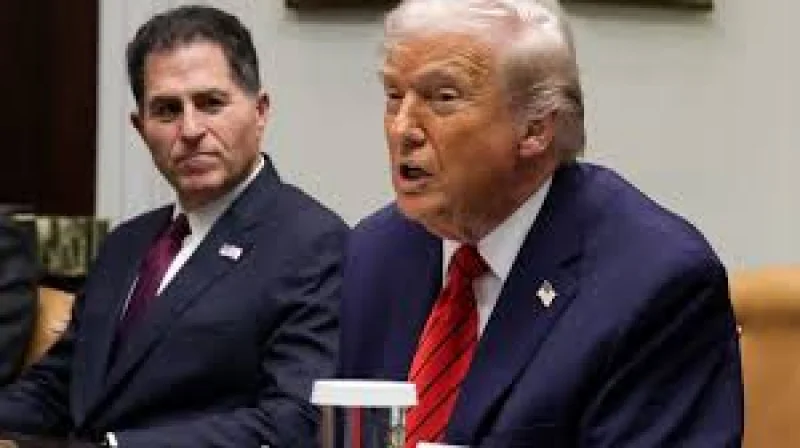
Donald Trump’s latest ethics filing put Dell Technologies back on traders’ screens, showing a position opened in February just as the president publicly urged supporters at a May event to “Go out and buy a Dell.” The stock moved into the middle of a broader rush to decipher what Trump has been buying, selling and praising this year.
The filing, released in mid-May, logged more than 3,700 transactions in Trump’s name and showed dozens of holdings beyond Dell, including ServiceNow, Adobe, Texas Instruments, Oracle, Broadcom and Motorola Solutions. That paper trail has become a market event of its own, because the names in it have often overlapped with the administration’s technology agenda and with sectors that have benefited from Washington attention.
Dell’s appearance in the disclosure drew extra notice because it came alongside another trade that is now hard to ignore in hindsight: a purchase of NVIDIA Corp. shares in early January. That buy preceded Commerce Department approval of sales of certain Nvidia chips to China, a sequence that has kept investors and ethics watchers combing through the filing for clues about what Trump knew, when he knew it and whether the market was already moving in the direction he later promoted.
The timing matters because Trump has not limited his remarks to one company. On May 22, he called Micron Technology “great,” and by May 26 the memory-chip maker had closed near $896 and crossed $1 trillion in market value for the first time. Intel has also been in the spotlight, rising roughly 190% this year after the White House said on May 18 that the government equity stake it acquired for $8.9 billion had swelled past $50 billion.
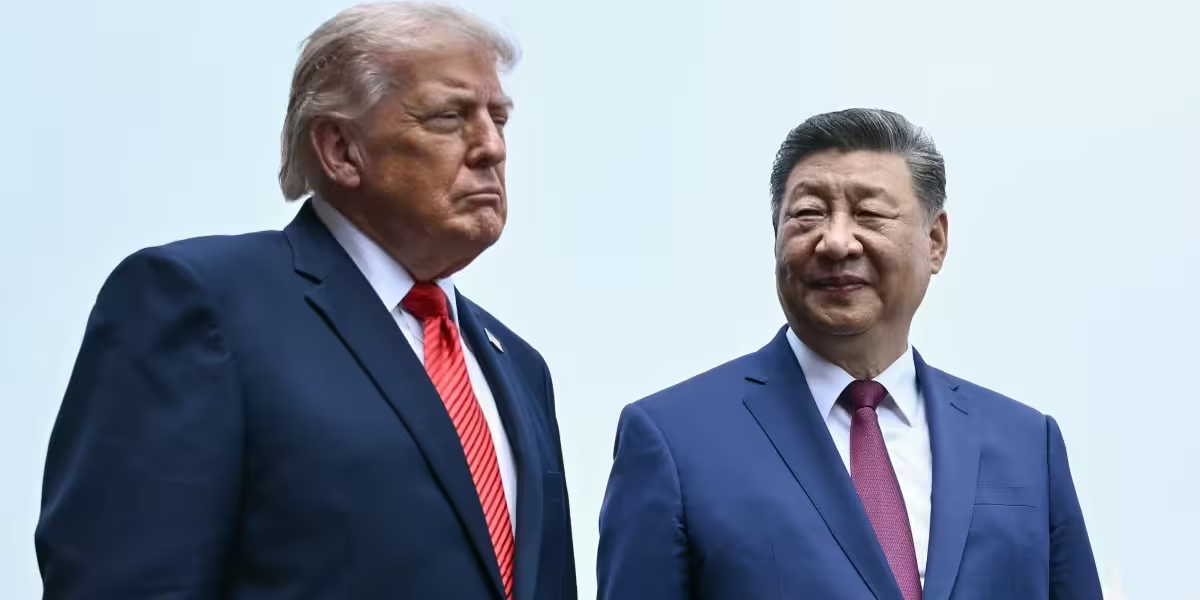
That is the backdrop for the jump in attention around Dell share price. Trump’s comments, his filings and the market’s reaction have started to move together in a way that makes each new remark matter more than it otherwise would. For traders, the question is no longer just what the president owns. It is how quickly a name can turn from a disclosure item into a tradeable signal.
Trump added another layer to that dynamic on May 26 with a full-throated defense of the prediction market industry in a Truth Social post. On Kalshi, a contract asking which companies the United States will take a stake in this year had drawn more than $740,000 in volume, with traders pricing Micron near 42%, quantum names Rigetti and D-Wave above 80% and Nvidia at 13%. That market is not a forecast of policy, but it shows how quickly investors are turning the administration’s tech moves into wagers.
Trump’s filing also disclosed holdings in Oracle, Broadcom and Motorola Solutions, companies with clear ties to the administration’s priorities. Oracle has links through co-founder Larry Ellison, a lead role in the Stargate AI infrastructure project and its part in the deal to keep TikTok running in the United States. Broadcom supplies the custom chips behind the US data center buildout that has become a centerpiece of the tech agenda. Motorola Solutions provides police radios, dispatch software and public-safety surveillance gear. The White House says Trump’s portfolio is independently managed by a trust, that he provides no input and that there are no conflicts of interest.
What remains unresolved is how much of this is coincidence and how much is choreography. Trump has openly praised companies whose fortunes have then become harder to separate from policy, market speculation and presidential branding. When a disclosure with more than 3,700 transactions lands in mid-May and a rally call lands weeks later, the line between personal investing, public signaling and market-moving power gets thinner than ever.
