


The UK broke its May heat record for a second day in a row on Tuesday, with Kew Gardens in south-west London recording a provisional 35.1C as much of England and Wales stayed in an official heatwave.
Cardiff’s Bute Park reached a provisional 32.3C, while Wales also set May records on consecutive days. On Monday, Kew Gardens recorded 34.8C and Hawarden Airport in Flintshire hit 32.2C, underscoring how quickly the heat spread across the country.
Six amber heat health alerts issued by the UK Health Security Agency cover much of England and remain in force until Thursday. The warning says significant impacts are likely across health and social care services, as hot weather continues to place pressure on people and public services.
The latest readings pushed the country well past the long-standing benchmark for May heat. Before Monday and Tuesday, the highest temperature ever recorded in May in the UK was 32.8C, set in 1922 and matched in 1944. The Met Office said: “Until yesterday, the highest temperature in May was 32.8C, but we've now exceeded that record on consecutive days by a full two degrees Celsius.”

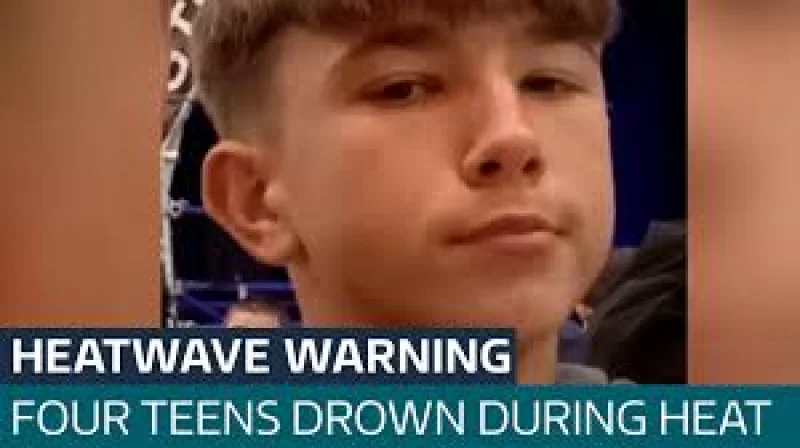
Behind the numbers is a week that has already turned deadly around water. Five young people and one man drowned in separate incidents in recent days, including a body recovered from the River Ribble on Tuesday evening after a 12-year-old boy got into difficulty while swimming with friends. A body was also recovered in the early hours of Tuesday morning at Rother Valley Country Park in South Yorkshire after a teenage boy went missing there.
Other deaths linked to the heat and water risk came over the same period. A 13-year-old boy died on Monday after getting into difficulty in a reservoir in Halifax, West Yorkshire. At Kingsbury Water Park in Warwickshire, the body of a teenage girl was recovered on Monday evening. A man in his 60s died at Tregirls Beach near Padstow, Cornwall, on Monday after running into the sea to help two relatives who got into difficulty, and on Sunday 15-year-old Declan Sawyer died at a lake in Lincoln.
The Royal Life Saving Society said warmer weather unfortunately sees an increase in accidental drownings. The Met Office warned that people also face the risk of cold shock, because sea and other open water temperatures remain much lower than the air even during a heatwave.
The weather is being driven by what the Met Office described as the influence of warmth building under an area of high pressure near the UK. For much of England and Wales, the practical test for a heatwave has now been met: in northern and western areas, temperatures must reach 25C for three days in a row, while in London and the Home Counties the threshold is 28C for three days in a row. With the hot spell still active and health alerts running to Thursday, the immediate issue is not whether the country has entered a heatwave, but how many more days it can remain in one without more damage.
