


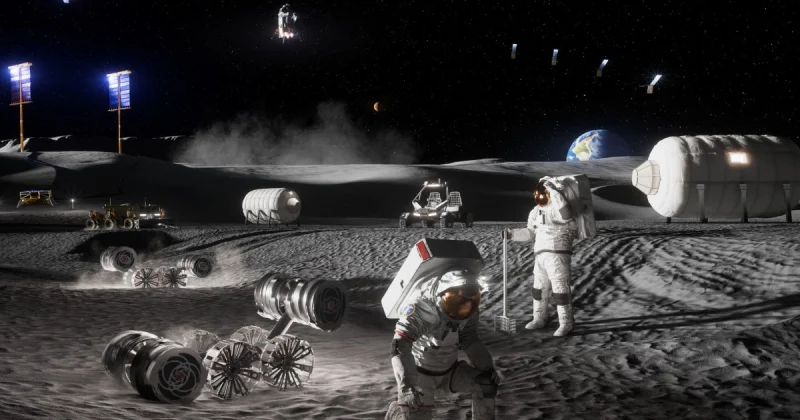
NASA on Tuesday laid out plans for three uncrewed missions to the moon later this year, including one that will use a Blue Origin lunar lander to carry two science and technology payloads. The missions, named Moon Base 1, Moon Base 2 and Moon Base 3, are the first steps in a larger push to scout the lunar south pole and prepare for astronauts’ return.
The first flight is scheduled for no earlier than this fall. Jared Isaacman, who described Moon Base 1 as the first privately funded lunar lander mission in history, said the program is meant to build momentum without rushing straight to a permanent outpost.
“We are not jumping right into the glass dome moon base,” Isaacman said. “We intend to take an iterative approach, sending a demand signal to industry for a lot of landers and rovers and tech demonstrations, and all the scientific payloads these missions can accommodate.”
Moon Base 2 will use a lander built by Astrobotic to transport more than 1,000 pounds of cargo and a moon rover to the surface. Moon Base 3 will study lunar swirls and deliver payloads from the European Space Agency and South Korea’s space agency, broadening the scientific reach of the campaign beyond a single landing site.

The announced missions fit into NASA’s broader moon base roadmap, which the agency said is expected to unfold in phases through 2032 and beyond. Carlos Garcia-Galan said the first phase will include 25 launches, 21 landings and about 4 metric tons of cargo delivered to the moon’s surface, a heavy lift that underscores how much of the work will happen robotically before astronauts arrive.
NASA said the first phase will run through 2029. From 2029 to 2032, the agency plans to assemble semipermanent facilities that would allow early habitation on the moon, and starting in 2032 it aims to achieve a sustained presence on the lunar surface.
Blue Origin’s role comes as part of a wider set of awards NASA announced Tuesday to private aerospace companies. The agency is leaning on commercial firms to carry science instruments, test hardware and build the logistics chain it says will support a permanent base.
For Isaacman, the moon program is also a rehearsal for something farther out. He said the lunar base will help NASA sharpen the skills it will need to eventually go to Mars, and he put the price of that ambition at about $20 billion over the next seven years.
“We’re talking about a $20 billion investment over the next seven years to establish that enduring presence on the moon,” Isaacman said. The plan now has a schedule, a set of contractors and three named missions. What it does not yet have is a human crew, and that gap is where the real test begins.
