


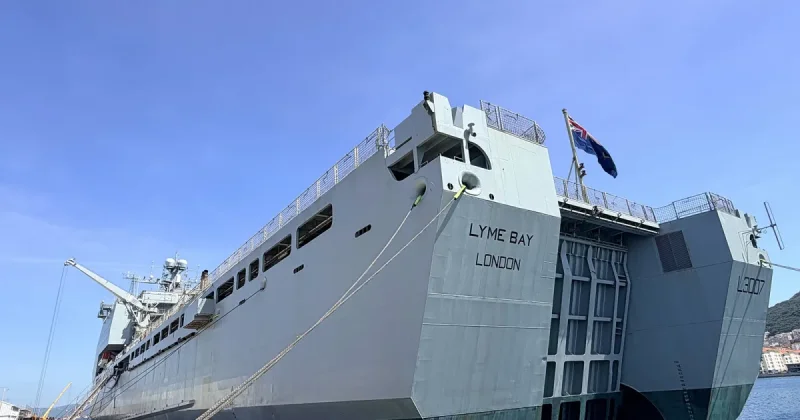
British forces have been training to use high-tech mini submarines to clear mines from the Strait of Hormuz, but they will not start the job until the United States and Iran reach a deal that ends the fighting. On Friday, British officials invited journalists from three U.S. news organizations to Gibraltar to watch the preparation effort aboard the RFA Lyme Bay, which would serve as the flagship of a British-led mine-clearing operation.
The plan is built around a simple but difficult task: find the mines, neutralize them, and keep the waterway open long enough for ships to move again. British officials said reopening the strait is expected to take months, not days, and that the first phase would be to clear a roughly 1,000-yard-wide corridor so about 2,000 ships and 20,000 crew members can leave the Persian Gulf. A second 1,000-yard-wide corridor would then be cleared to let ships back into the strait.
Al Carns, a British defense official, said the Royal Navy has spent years sharpening the tools for that mission. “I would always say the Royal Navy is the best in the world,” he said, adding, “We’ve also professionalized and really advanced our mine hunting capabilities over the last ten to fifteen years, some in collaboration with the French but also with our NATO allies and partners.”

The display in Gibraltar came as the British and French work with other European allies to assemble the ships and support vessels needed for a coordinated clearance effort. The RFA Lyme Bay was docked there during the media visit, while Britain has already sent a destroyer to the Persian Gulf region and France has sent the Charles de Gaulle. More vessels from Germany, Spain, Portugal and Italy are expected to follow, as officials try to build the force needed to reopen one of the world’s most sensitive chokepoints.
That wider effort also shows the limits of the U.S. Navy’s current mine-sweeping capacity. The Pentagon is replacing its aging fleet of Avenger-class minesweepers, including the 36-year-old wooden-hulled USS Patriot, even as the crisis in the Gulf has made those capabilities more urgent. British and French officials have co-chaired a series of meetings in Europe to gather the large number of mine sweepers and other vessels required to clear the strait.
Behind the scenes, the method is highly technical. A British naval officer said Britain, Germany and other NATO allies have invested in autonomous submarines that scan seawater and the seafloor for mines. Once a mine is found, divers place explosives on it or detonate explosives nearby, a slow and careful process that has to be repeated many times before a corridor is safe enough for traffic.
The stakes extend far beyond the ships waiting in the Gulf. The effort to reopen the Strait of Hormuz is tied to a wider war and an energy crisis affecting 40 countries, and the mine-clearing plan cannot begin until the ceasefire framework is in place. For now, Britain is training for the moment after the deal, not the moment before it, and the message from Gibraltar was plain: the Navy is ready to move, but only when the shooting stops.
