


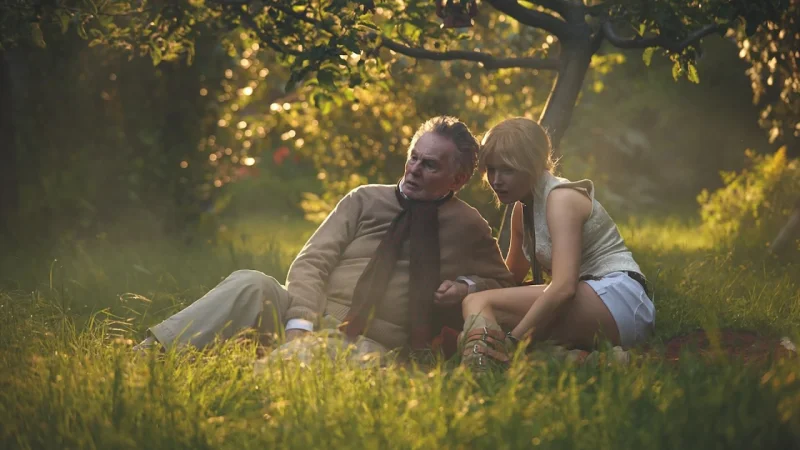
Kate Moss said yes in 2001, and Lucian Freud set about turning that agreement into Naked Portrait 2002. Moss & Freud, a new film with Ellie Bamber as Moss and Derek Jacobi as Freud, returns to the sitting that produced one of the painter’s best-known late works.
The film marks the feature debut of writer-director James Lucas and presents itself as a drama built around an art-world encounter that carried real risk for both sides. Freud, born in Berlin and brought to London with his family in 1933, took British nationality six years later and became known for portraiture, especially nudes. Moss, born in Croydon in 1974, had begun modelling at fourteen by the time she agreed to sit for him.
What made the arrangement unusual was not only who was in the room, but how long the room would matter. Freud’s daughter Bella tells Kate in the film that sitting three evenings each week might take a whole year before the painting was complete. That fits the artist’s method: his first full-length nude did not appear until 1966, and his work was built on long, uncompromising sittings rather than quick likenesses.
The film’s hook is obvious. It takes a subject already wrapped in legend and tries to show how the legend happened. Moss was not just the model at the center of the story; she was one of the film’s executive producers as well, a detail that gives the project an insider’s claim to the material even as it reduces the distance a drama usually needs. The result, by this account, is less a daring reinvention than a shallow reconstruction of how Naked Portrait 2002 came about.
That narrowing matters because Freud’s studio was not a casual place. He was known to become angry if a sitter was even a few minutes late, and his method depended on patience from people who had little reason to give it. Moss & Freud tries to mine that pressure, but the story it tells is already heavily bounded by what is known: the 2001 sitting, the finished painting in 2002, and the fact that one of the world’s most photographed women chose to disappear into the slow demands of Freud’s frame.
For viewers, the question is whether the film finds anything beyond the outline of the event itself. The answer, at least from the material it offers, is that the artwork remains the main thing of consequence. The painting outlasted the sitting. The sitting outlasted the gossip. And the movie now exists mostly as a reminder of how much of Moss’s image was suspended, for four hours at a time, in Freud’s studio.
