


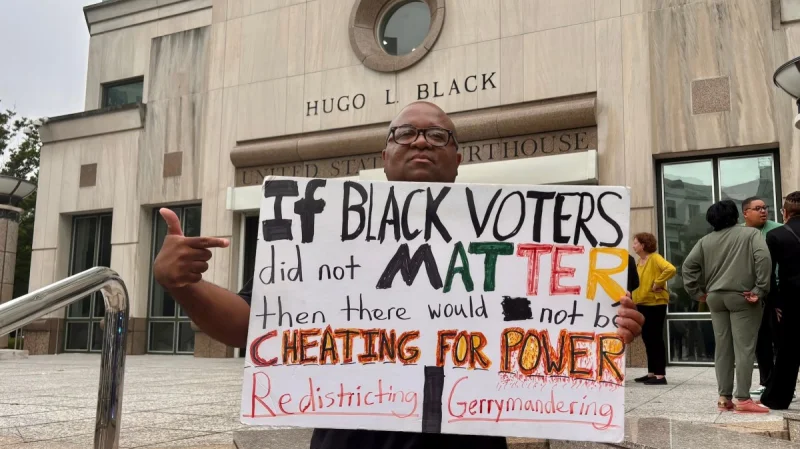
A three-judge federal court panel on Monday restored an Alabama congressional map with two majority-Black districts for the 2026 midterm elections, reopening a fight over redistricting in Alabama that the Supreme Court had only recently appeared to settle. The same panel said the map the justices had allowed Alabama to use was intentionally discriminatory against Black voters.
The ruling matters because Alabama’s election calendar is already moving toward the next congressional cycle, and the panel’s decision puts the state back under a map it had been told to adopt after years of litigation. The judges said in a unanimous opinion that they could not see their way clear to forcing Alabamians to vote in 2026 under a districting plan tainted by intentional race-based discrimination. They also wrote that they did not lightly intrude in state affairs, but that their earlier review of the undisputed evidence left them in no doubt that Alabama’s legislatively enacted plan intentionally discriminated based on race in violation of the Constitution.

The dispute has been building since 2023, when the Supreme Court ordered Alabama to create a new majority-Black congressional district in Allen v. Milligan. Last year, after a full trial, the same three-judge panel concluded that Alabama had discriminated against Black voters by refusing to create that district. The Supreme Court’s conservative majority later abruptly reversed course after its April Louisiana v. Callais decision, and then allowed Alabama to use a map with only one majority-Black district for November’s midterms, coming just one week before the state’s primary.
The panel said its re-examination of the case in light of Callais produced the same result. In its opinion, issued Tuesday and running nearly 80 pages, the judges reaffirmed intentional racial discrimination and said, in effect, that the issue was not a close one. Their view was blunt: “we do not find the issue particularly complex or close.”
That leaves Alabama in the middle of a legal standoff that pits the state’s latest map against findings already made by the federal court and, earlier, by the Supreme Court itself in Allen v. Milligan, where the justices agreed Alabama had violated the Voting Rights Act. For now, the panel’s ruling restores the two-district plan for 2026, but the wider redistricting fight in Alabama is still being driven by the same conflict between the Voting Rights Act and the Constitution.
