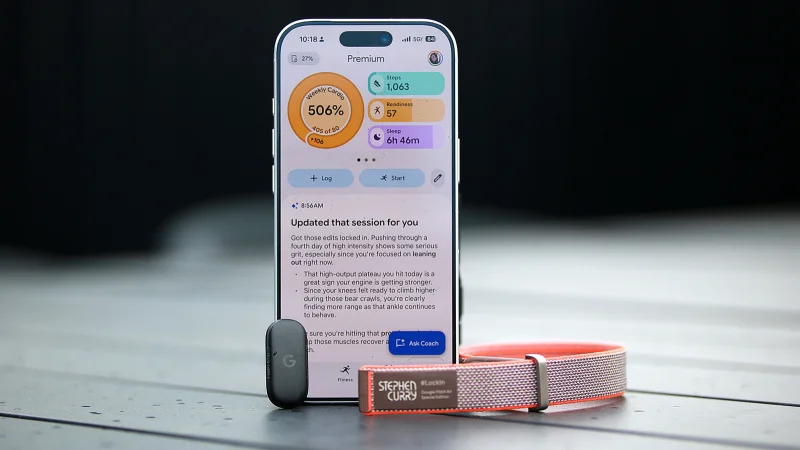
Google has moved directly into Whoop territory with Fitbit Air, a screenless wearable that can be dropped into a range of bands and is meant to live almost entirely through the Google Health app. The device is thinner and lighter than the Inspire 3, and it arrives as Google prepares to replace the Fitbit app with Google Health.
The contest matters because Whoop has owned this style of product for years, first launching a screenless wearable in 2015 and then backing that bet with fresh money. In March, Whoop raised $575 million and hit a $10 billion valuation, a sign of how valuable the market for always-on, display-free trackers has become. Google is not nibbling at the edges here. It is aiming squarely at the same customer who wants coaching, recovery data and workout tracking without a watch face glowing on the wrist.

Fitbit Air itself is tiny. Without a band, it measures 34.9 x 17 x 8.3 mm and weighs 5.2 grams. It has a Google logo on top, the sensor array on the bottom and an LED light on the edge, a layout that makes clear where the company wants the attention to land: not on the hardware, but on the software and the data it collects. Google also sent three straps, and the performance loop band was probably the least obtrusive, even if it was a bit hard to secure because of the way the velcro strap is set up.
That dependence on software was obvious during testing. Because the device has no display, the experience flowed through the Google Health app and AI Coach, which told the reviewer the readiness score was 48 out of 100. After a 54-minute HIIT class at 9AM, the app first greeted the workout with, “You clearly didn't get the memo about taking it easy today.” It later replaced that with, “Adjusted your HIIT session details,” before laying out the numbers: 41 minutes in vigorous cardio zones and a peak heart rate of 169 bpm.
The result is a product that feels less like a standalone gadget than a bid to rewrite the Fitbit experience around coaching and recovery. That makes its success depend on whether Google Health can do what the old Fitbit app did, only more convincingly, while convincing users they need a screenless tracker in the first place. For now, Fitbit Air looks like Google’s clearest challenge yet to the company that defined the category.