


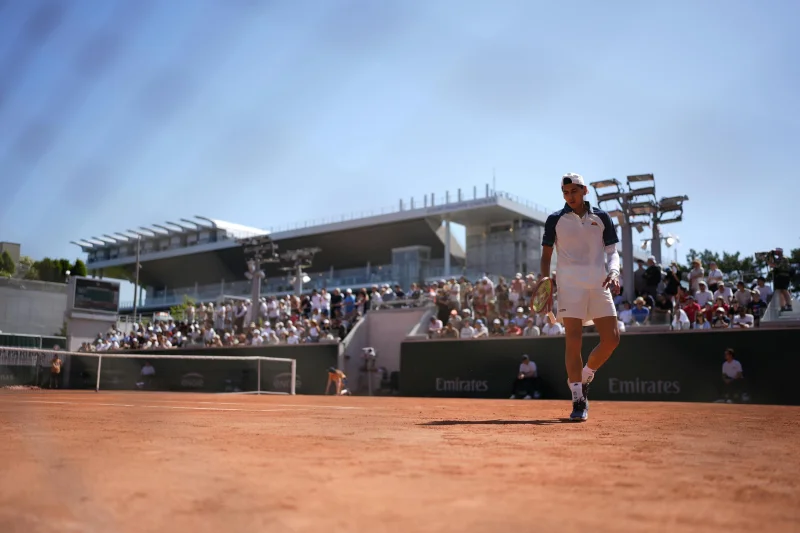
ARYNA SABALENKA made the perfect start on Chatrier on the sweltering third day of Roland Garros, breaking Bouzas Maneiro immediately for 2-0 as the world No. 1 again took centre stage in Paris.
The opening burst mattered because the live question hanging over Sabalenka was not whether she belongs at the top of the women’s game, but whether she can turn that status into a major on clay. ’s coverage framed it plainly: can the world No. 1 win a major on a non-hard surface? The answer may be yes, but the uncertainty remains in Paris, where day three began under punishing heat and every fast start carried extra value.
That was only part of the picture. The same live report kept moving across the grounds as results and scorelines shifted elsewhere, with Alexei Popyrin leading Zachary Svajda 6-3, Donna Vekic up 5-2 on Alice Tubello, and Tallon Griekspoor level with Matteo Arnaldi at 3-3. Marin Cilic and Moise Kouame were locked at 2-2, while the 17-year-old home wildcard was making his Grand Slam debut in front of a French crowd that had plenty else to watch.
It was a day built for live updates, and Daniel was reporting them as they happened from Roland Garros. The feed opened with a greeting to readers in French before settling into the rhythm of the tournament: brief, immediate, score-driven. Even the tone fit the setting, with the coverage welcoming everyone to Roland-Garros 2026 on “third day” before turning to the hard facts of who was ahead and who was under pressure.
Sabalenka’s position remains the one that shapes the wider conversation. She is the top seed, the player everyone measures, and the one whose progress on clay will keep drawing scrutiny as long as the tournament lasts. A straightforward opening game or a routine scoreline would not have carried the same weight; breaking Bouzas Maneiro straight away and moving to 2-0 on Chatrier did. It gave her an early platform and reminded everyone that the day’s biggest name was already in command while others across the venue were still trying to find their footing.
But the tension in Paris is not just about one match, or one player. It is about whether a dominant hard-court force can translate that form to a slower surface, against opponents and conditions that punish even the smallest lapse. The heat on day three only sharpened that test. Sabalenka’s early lead was a statement, but the broader answer to the clay-court question will come only if she keeps stacking days like this one.
