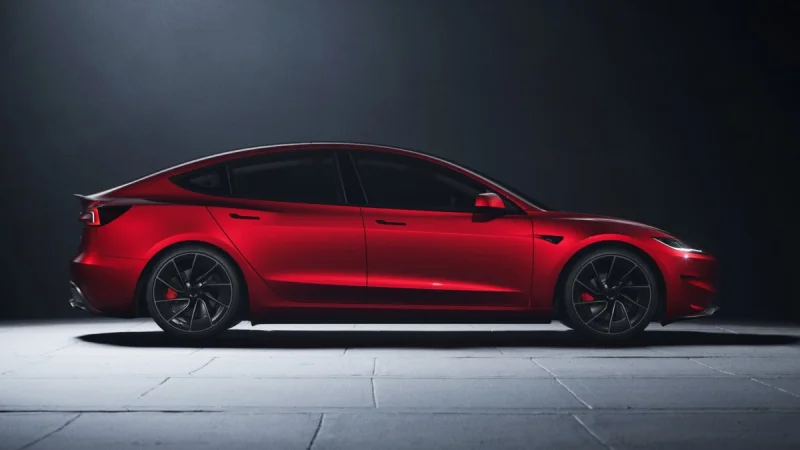
Tesla’s engineering chief says a tri-motor version of the Model 3 is still on the company’s mind, even if it is not near the front of the line. Lars Moravy, the company’s vice president of vehicle engineering, said the idea of a Plaid-style Model 3 is something he thinks about constantly.
Moravy’s comments point to a car that would borrow the kind of hardware now associated with the Model S Plaid, including carbon sleeves and permanent magnet motors. In Tesla’s own telling, a tri-motor Model 3 would be a work-for-reward decision inside the company, the sort of passion project engineers keep circling back to even as other programs take priority.

That matters because Tesla’s current Model 3 Performance AWD already sits near the top of the compact sedan’s range. It makes 510 horsepower, reaches 60 mph in 2.9 seconds, offers 309 miles of EPA-estimated range and starts at around $54,990. A Plaid Model 3 would likely blow past 1,000 horsepower and push into sub-2-second 0-60 territory, a level of acceleration that today belongs only to the Model S Plaid in Tesla’s lineup.
The engineering logic is straightforward. The carbon-wrapped rotor used in the Model S Plaid’s tri-motor setup allows for significantly higher RPM and sustained output without thermal degradation, which is the kind of detail that turns a fast EV into a headline-grabber. But Tesla is not treating the Model 3 project as a near-term priority. Cybercab, the next-generation affordable model and Optimus scaling are higher on the list, and that is where the company is focusing its time and resources.
That gap between fascination and execution is familiar at Tesla. The company has a long history of concepts living in engineering discussions for years before they ever reach production, and Moravy’s remarks place the tri-motor Model 3 firmly in that category for now. For enthusiasts, the appeal is obvious: a smaller car with Model S Plaid hardware would be the sort of thing that could reset expectations for performance sedans. For Tesla, though, it remains an internal idea, not an announced program, and the company’s next moves will be shaped first by vehicles it has already put at the top of the stack.