


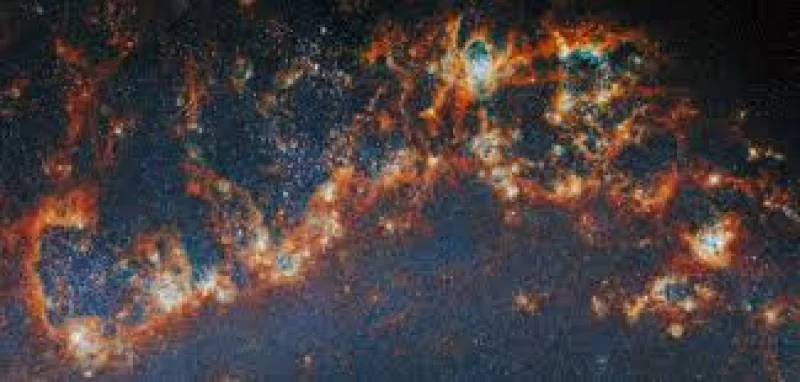
NASA released a near-infrared image on May 6, 2026, showing a section of one of the spiral arms of Messier 51, a nearby spiral galaxy better known as the Whirlpool Galaxy. The image is part of a study using the James Webb Space Telescope that looked at nearly 9,000 star clusters across four nearby galaxies.
The finding that more massive star clusters emerge more quickly from the clouds they are born in gives astronomers a sharper look at how stars take shape in different environments. That matters because learning how stars form helps scientists understand how galaxies evolve, how gas and dust move through them and where planets are most likely to form.
Messier 51 is one of four nearby galaxies NASA said were observed for the study, which focuses on star formation rather than the picture alone. The telescope’s near-infrared view lets researchers peer through dust that can hide the youngest clusters, giving the team a clearer read on the stages between birth and visibility. By comparing thousands of clusters, scientists can start to see which patterns hold across different galactic neighborhoods.
The result also points to a simple but important split in how clusters develop. The larger ones do not linger as long inside the clouds where they form, while smaller clusters appear to remain embedded for longer. That difference can shape how researchers model the life cycle of stellar nurseries and the conditions that influence future planetary systems. For astronomers, the image is striking; for the science, the study is a step toward mapping how galaxies build themselves, one cluster at a time.
