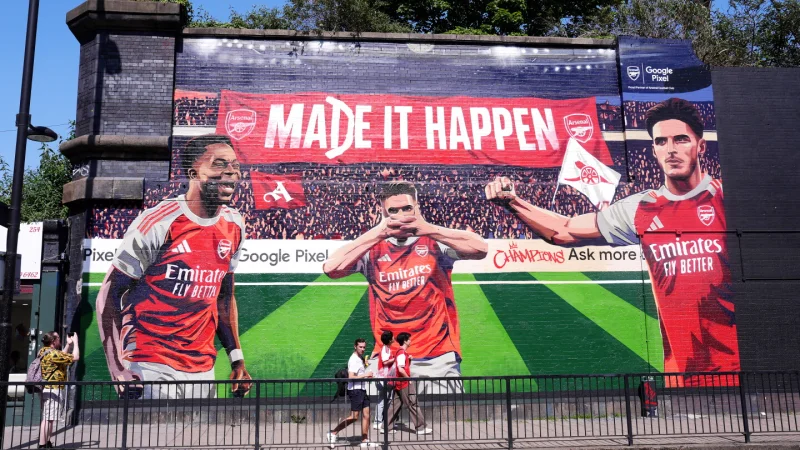
Late into the night, Arsenal supporters gathered on the streets around Finsbury Park station to celebrate. What began with hundreds quickly swelled to thousands, filling Gillespie Road, Benwell Road, Hornsey Road and the little shortcut past The Plimsoll pub as people gripped each other by the shoulders and moved toward the stadium.
The crowd chanted, “What do you think of shit? Tottenham! Thank you. That’s all right!” and a firework was let off, then another, in the middle of the noise. Some fans FaceTimed relatives while others posed for selfies with Ian Wright, and the mounds of detritus outside the station looked, in the article’s own words, like an offering to a vengeful deity.
It was a scene that belonged to Arsenal but also to London itself. The club’s tube station was named for the team rather than the locality and was rebranded in the 1930s at Herbert Chapman’s request, a reminder that Arsenal has long been stitched into the city’s identity rather than merely planted in it. The club draws its fanbase as readily from Ithaca and Indore as it does from Islington, while most of its players and staff live in the Hertfordshire commuter belt.
That mix matters because Arsenal is not the sort of club that can be contained by a single postcode or a single type of supporter. London is constantly shifting and innovating, adding and shedding layers, plural and complex and multipolar and diverse, and Arsenal has come to mirror that better than most clubs. It is represented by figures including Thierry Henry, Tony Adams, Liam Brady, Katie McCabe, Declan Rice and Pat Rice, and its history holds multiple eras that are all recognizably Arsenal, from George Graham to Arsène Wenger to Mikel Arteta.
There was jostling throughout the celebration, but no free-kicks were awarded. The joke lands because modern football is usually divided by membership tiers, pricing tiers and devotion tiers, the small borders that keep people apart even when they are standing in the same ground. On this night, those borders dissolved in the street outside Finsbury Park station. The question now is not whether Arsenal can summon a crowd. It is how often a club can still produce a night when thousands behave as though the city itself has decided to sing along.