


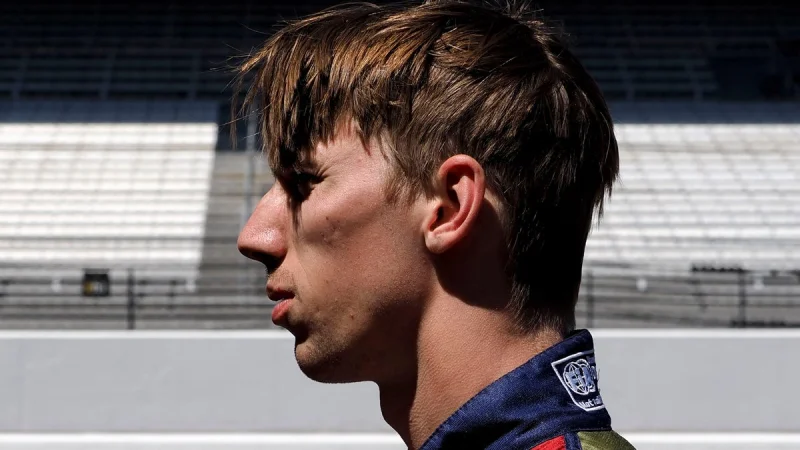
Takuma Sato says he will not be satisfied until he wins the Indianapolis 500 for a third time, setting his sights on another victory ahead of the race’s 110th running. The Japanese driver, who has already won the event twice, said the target remains unchanged even after years at the center of one of motorsport’s biggest stages.
Honda organized a round table interview with select media, including The Drive, and Sato used it to trace how the Indy 500 went from something he barely understood to the race that defined his career. Born in Tokyo, he said his first-ever race was the Formula 1 Japanese Grand Prix in 1987, and that as a child he once saw a car on TBS at age six or seven and thought: “That must be the Indy 500.”
Sato entered Formula 1 in 2002 with Jordan and later had stints at BAR and Super Aguri, with his best finish coming in third at the 2004 US Grand Prix. Even so, he said the Indianapolis 500 kept pulling him back because of what it represented rather than where it sat on the calendar. He described the race as something built on history and tradition, unlike the Japanese Grand Prix, the Nürburgring, Spa-Francorchamps or Monte Carlo.
His first run at Indianapolis did not give him much clarity. “My first Indy 500, I didn’t really quite understand what is the Indy 500,” he said, explaining that repeated exposure was what made the event click. The scale of it, he said, only became obvious over time, as did the weight of what it means to win.
That understanding sharpened in 2012, when Sato said his third Indy 500 became the turning point of his race career. He recalled a last-lap attempt on Dario Franchitti in turn 1 that ended with him in the wall. “In my third [Indy 500], 2012, in turn 1 on the last lap, that was definitely the turning point of my race career,” he said. “We were there very competitively, we were challenging for the win, but we couldn’t win this race. [With] how difficult this race is, you need everything.”
Sato eventually won the Indianapolis 500 twice, but he said the circumstances of his 2020 victory still left him feeling as though something was missing. That is why the race continues to matter to him now, not as a memory to defend but as unfinished business. Walking from Gasoline Alley to pit lane, he said, remains part of the lure: “It’s always nice to walk through Gasoline Alley to get into the pit lane, and you can hear the people’s noise—almost 300,000 people,” he said. “That is a mega feeling. Sensational. There’s nothing like it.”
For Sato, the unfinished part is simple. Two wins are not enough to settle the Indianapolis 500 in his mind, and the 110th running gives him another chance to close the gap between what he has already done and what he still wants to prove. With the crowd, the history and the pressure all folded into one afternoon, he is still chasing the one result that would make the story feel complete.
