


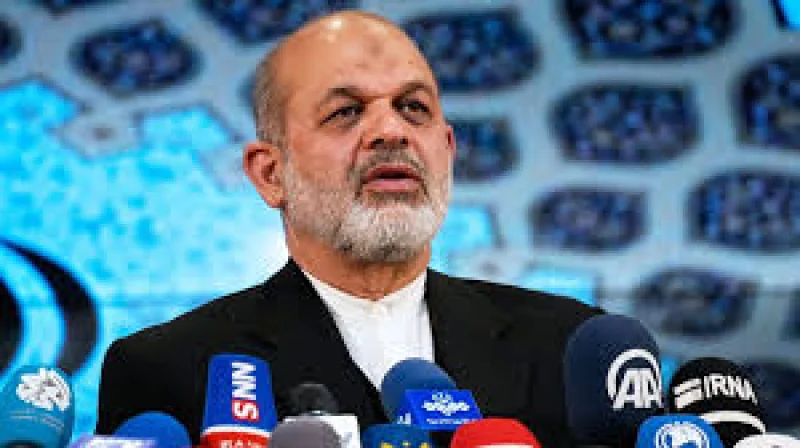
Ahmad Vahidi has emerged as one of the men helping steer Iran through war after the killing of Ayatollah Ali Khamenei and dozens of other top figures in Israeli airstrikes. The former intelligence officer, who now heads the Islamic Revolutionary Guards Corps, is part of a tight circle of commanders that senior Iranian officials say runs the state’s key decisions through Khamenei’s 56-year-old heir, Mojtaba.
That inner group does not look like a normal civilian leadership. It is made up largely of current or former senior Guards commanders who were promoted to generals while still in their late 20s or early 30s, men whose political power grew out of the Iran-Iraq war and never really faded. Vahidi’s role matters now because the war has killed about 50 top political and military leaders, yet the system has kept functioning and the people who know how to command force still appear to be in charge.
Khamenei was killed by Israel on Feb. 28 in the opening airstrike of the war against the Islamic Republic, and his son Mojtaba succeeded him. Iranian officials maintain that all major matters are now handled by the 56-year-old heir, but the practical machinery behind that claim is a familiar Guards network. That network reaches beyond one man and includes figures who came of age during the republic’s most formative security battles.
Mohammad Bagher Ghalibaf is one of them. He has served as speaker of the Iranian Parliament since 2020, after a career that included commanding the Guards air force, leading the national police and serving as mayor of Tehran. Last month, he also negotiated directly with the United States in Pakistan, a reminder that the same men who helped build Iran’s security state now sit across from foreign powers as its political face.
Vahidi’s own path follows the same pattern. He was first a commander of the Quds Force in 1988, then later served as defense minister and interior minister. After U.S. and Israeli airstrikes killed his predecessor in March, he took over the Guards, putting an old security hand at the center of a crisis that has already claimed so many others.
The system behind him was built for this kind of pressure. The Islamic Revolutionary Guards Corps was founded in 1979 to protect the new revolution and its leader, and the brutal eight-year war with Iraq that began in 1980 forged the generation that now dominates Iran’s power structure. Afshon Ostovar, an expert on Iran’s military and security elite, once described Ghalibaf’s campaign-era image change by saying he showed up on election day looking like Don Johnson on “Miami Vice.” The line captured something important: these men have long learned to reshape themselves for politics without ever leaving the Guards behind.
That is why the deaths have not produced a collapse or paralysis. The war has removed senior names, but it has not broken the habits of command, or the hard core of men who have spent four decades turning military authority into political rule. For now, Iran looks less like a state decapitated by war than one still governed by the same security class that built it.
